
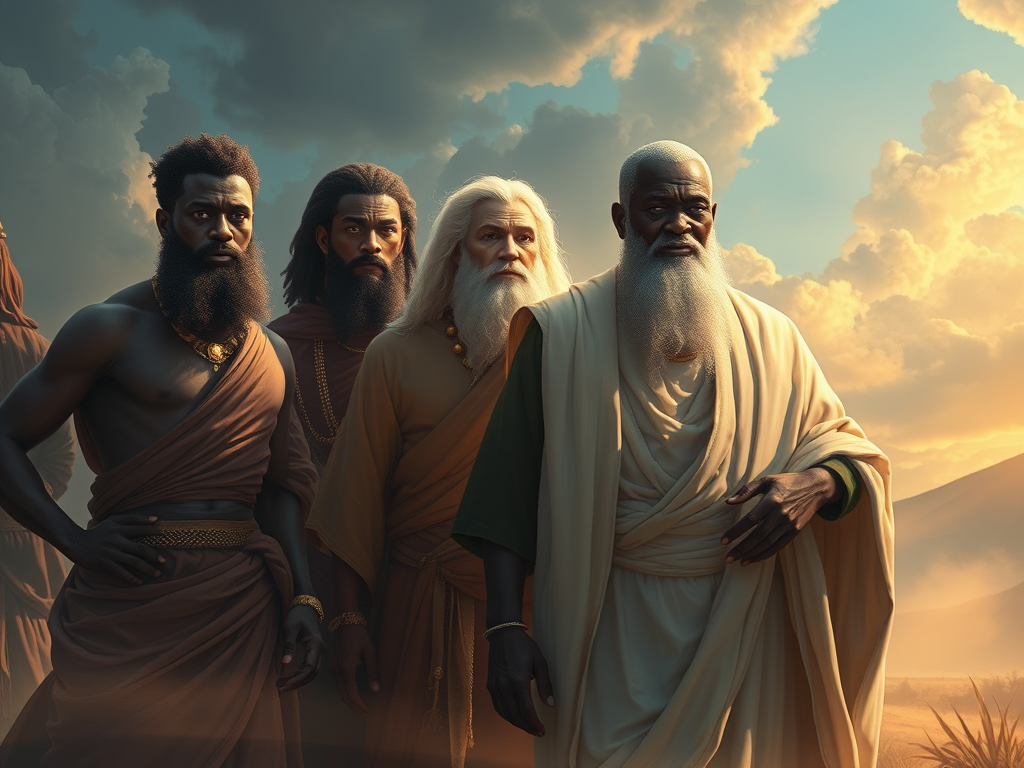
Many Christians have misunderstood the term “Ham saw his father nakedness.” They continue to misinterpret it as Ham engaging in sexually abominable behavior with his father, but this is incorrect. To gain a comprehensive understanding of these terms, it is necessary to examine the events that occurred before the flood but are not documented in the Bible but can be found in the Apocrypha.
Noah and his family weren’t the only ones on the Ark. One person who was also present on the ark was a woman named Naamah. She was Cain’s great-granddaughter, who later became Noah’s second wife. According to ancient texts such as the Book of Jasher, God directed Noah to bring her aboard the ark, even though she was not part of his plan. Naamah is mentioned in Genesis 4:22 as the daughter of Lamech and Zillah, and sister to Jabal, Jubal, and Tubal-Cain.
Read more: Exposed: How the Fallen Angels Created Religion
Naamah grew up in a corrupt environment created by Cain’s offspring. Unlike her people, she was distinguished by her modesty, self-control, and humility. Her character earned her a spot in Noah’s family before the flood when there were few good women. She eventually married Noah and was the last surviving member of Cain’s bloodline.
Her presence on the ark also ensured that humanity’s new beginning included a diverse range of cultural streams. Before marrying Naamah, Noah already had three children from his first marriage in Ham, Shem, and Japheth. This secret account is found in early traditions, but not in the Bible.
How Ham saw his Father’s Nakedness
What the bible did not reveal was that Naamah had a secret affair with Ham, one of Noah’s sons. Given her status as Noah’s second wife and Ham’s stepmother, this was an abomination to God. The Bible describes this in a euphemistic way, saying that Ham “saw his father’s nakedness.”
Read more: Explained: God Designed Every Man to be Polygamous
In Hebrew, and later explanations found in Moses’ laws, seeing a man’s nakedness implied having an affair with his wife. When a man and a woman marry, they become one body. So, if you take his wife to bed, you might as well have “seen his nakedness.”
Noah was unaware of Ham’s actions until Shem and Japheth informed him. This explains why the Bible says they “covered their father’s nakedness” (Genesis 9:23), which is a euphemism for respectfully disclosing the situation to Noah.
Naamah and Ham’s relationship resulted in the birth of a child named Canaan. This explains why Noah did not directly curse Ham or Naamah, but instead cursed their child, Canaan, and his descendants.
Another interesting fact is that in ancient times, mostly within the descendants of Cain culture, mothers and not fathers, named their children. Naamah gave her child the name Canaan, which translates in her culture as “the lowland one” or “the one brought low.”
Where the connection becomes obvious is that Cain’s descendants lived in the lowlands east of Eden. Their entire civilization was based on lowland culture, the plains, valleys, and flatlands far from the holy mountain. Because of the curse of their ancestor Cain, they were known as lowlanders.
Naamah came from that exact lowland world. When she joined Noah’s family, her lowland identity was carried through the flood, so she named her son Canaan to reflect both her and, later, his world. The Canaanite people rebuilt a post-Flood lowland culture that reflected their name. Some of the cultures they built included:
- Jericho → lowland
- Sidon → coastal lowland
- Sodom & Gomorrah → lowland plains
- Phoenicia → lowland coast
- Philistia → lowland valleys
As Canaan’s descendants grew, they mirrored Cain’s lineage in behaviour, embracing violence and wickedness. According to Numbers 13:33, certain Canaanite tribes, including the Anakim, Rephaim, and Amorites, had giant or powerful rulers.
You can now see why giants were able to repopulate the earth even after the Flood. This is because Naamah, a Cain descendant, may have passed on Nephilim DNA to her son, Canaan.
Additionally, the Canaanite also brought Baal worship to every nation through association on both land and in territory. This made God to hate every bit of the Canaanites tribe because they worshipped Baal and had Nephilim DNA from their ancestor Cain.
Sources
- Genesis 6:1-4 (Nephilim)
- Numbers 13:33 (Anakim)
- Deuteronomy 2:10-11 (Rephaim)
- Genesis 4:17-22 (Cain’s lineage)
- Genesis 5:28-32 (Naamah, wife of Noah)
- Jubilees 4:22 (Naamah’s lineage, extra-biblical text)
- Josephus, Antiquities of the Jews (mentions giants in Canaan)


Leave a Reply