
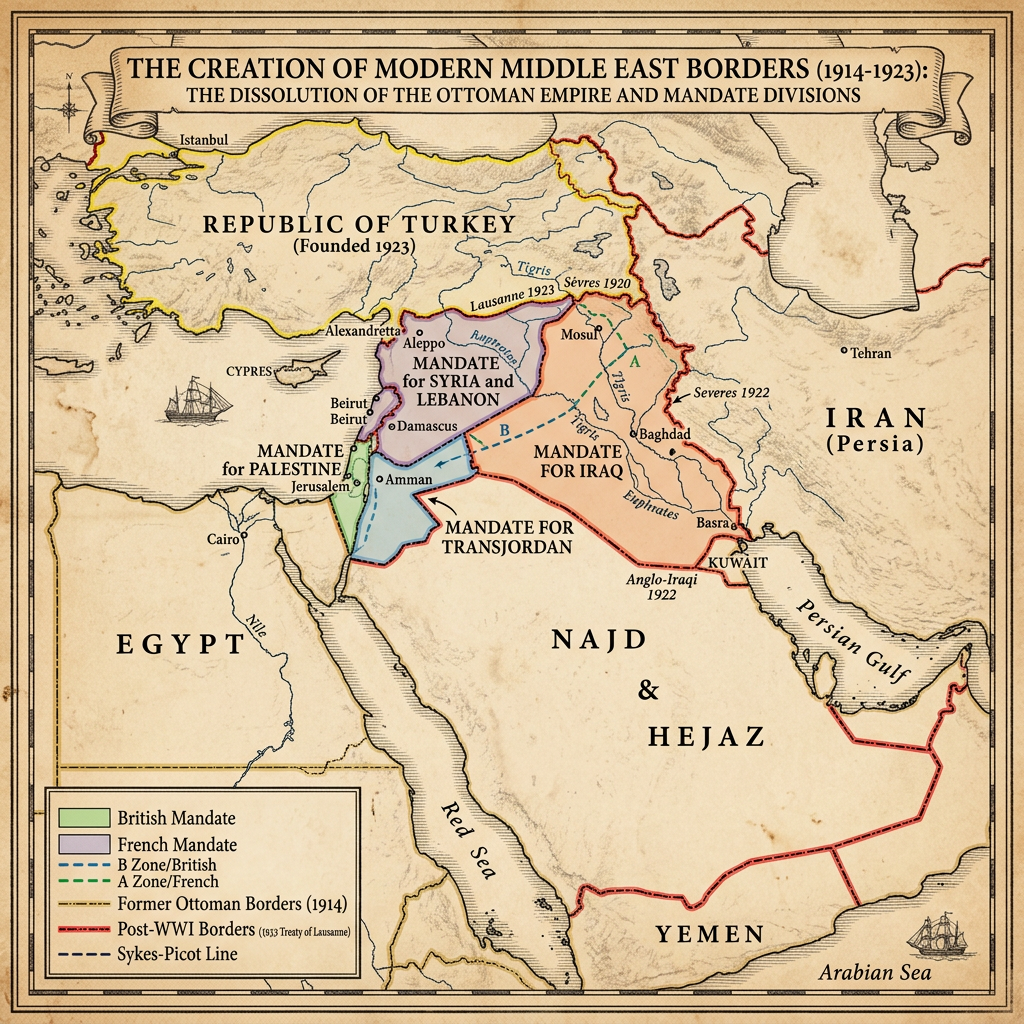
The Middle East is often associated with conflict, which is understandable. Much of the region’s modern political history has been characterized by instability, war, and competing interests. To understand why the Middle East exists in its current form, we must examine the historical events that shaped it.
Many of the foundations of the modern Middle East were laid during and after World War I, with further developments taking place during and after World War II. These events influenced territorial changes, the establishment of new political boundaries, and the region’s long-term stability.
Read more: Explained: Why Iran Has Been So Difficult to Invade for Decades
Before World War I, the Ottoman Empire ruled much of the Middle East, having controlled large portions of the region for centuries. However, the main Allied powers, especially France and Britain, started preparing for the potential Ottoman defeat during the war. Instead of letting the local populations decide their own political destiny, these powers bargained over the partition of Ottoman lands after the war.
One of the most important agreements was the Sykes-Picot Agreement of 1916, a secret agreement between Britain and France that defined their respective spheres of influence in the Middle East. After the defeat of the Central Powers, the victorious Allied nations formalized much of this division through a series of treaties and the newly established League of Nations mandate system.
Under this arrangement, Britain and France were given control of large portions of the former Ottoman territories and were tasked with administering them until they were deemed self-sufficient. In practice, this process enabled European powers to draw borders, form governments, and shape the political structure of much of the modern Middle East based on their strategic interests.
Many of the region’s current states emerged directly from these decisions, and the consequences of these arrangements continue to influence the Middle East today. This article gives a brief overview of how much of the modern Middle East came into being, while acknowledging that some countries, like Yemen, took a different historical route.
Turkey
While many regions of the former Ottoman Empire were divided between the victorious Allied powers, the Anatolian heartland took a different path. The emergence of modern Turkey was orchestrated by military resistance and nationalist reform led by Mustafa Kemal Atatürk.
The Ottoman Empire was founded on the Anatolian Peninsula. Following Ottoman defeat in World War I, the Allied powers imposed the Treaty of Sèvres in 1920, proposing a dramatic division of Ottoman territory.
Had the treaty been fully implemented, modern Turkey would be much smaller than it is today. Many historians believe that the treaty posed a serious threat to Turkey’s survival. The treaty ultimately failed, owing largely to the efforts of Mustafa Kemal Atatürk, later known as the founder of modern Turkey.
Between 1919 and 1923, Atatürk led the Turkish War of Independence against a coalition of foreign powers and domestic opponents that included Greece, France, Britain, Italy, Armenian forces, and supporters of the former Ottoman regime. His military victories forced the Allies to return to the negotiating table.
These achievements resulted in the Treaty of Lausanne in 1923, which established modern Turkey’s international borders. Atatürk emerged from the conflict as a national hero who protected Turkish sovereignty during a period of unprecedented political turmoil.
After achieving independence, Atatürk launched an ambitious modernization program. After observing Europe’s military, political, and economic development, he believed that Turkey needed to adopt many aspects of European society to become a strong and modern nation.
His most significant reforms included replacing the Arabic script with a Latin-based alphabet, extending women’s rights, instituting secular governance, reforming education, and encouraging Western styles of dress and social organization. In many ways, Atatürk hoped to transform Turkey into a modern European-style country.
At the same time, Atatürk advocated for Turkification, which sought to unite the population under a single Turkish national identity regardless of ethnic, linguistic, or cultural differences. This policy sparked opposition, particularly from the Kurdish population, and questions about Kurdish identity and autonomy have remained a major political issue in Turkey ever since.
Atatürk, like many other Middle Eastern leaders of the time, was motivated by two powerful ideas: modernization and nationalism. He believed that modernization explained Europe’s strength, while nationalism provided the unity required to build a strong nation-state.
After Atatürk’s death on November 10, 1938, his close associate Mustafa İsmet İnönü took over leadership and successfully maintained Turkey’s neutrality during the Second World War.
Syria and Lebanon
Unlike Turkey, many Arab regions of the former Ottoman Empire fell under direct European administration after World War I. This process was largely carried out through the League of Nations mandate system, which formalized Britain and France’s authority over various territories.
The origins of this arrangement can be traced to the Sykes-Picot Agreement of 1916, a secret wartime agreement between Britain and France that outlined how much of the Ottoman Middle East would be divided after the war. Under this agreement, France was granted influence over the territories that would later become Syria and Lebanon.
Officially, the mandate system was presented as a temporary measure to prepare societies for self-governance. In practice, however, it functioned largely as a form of colonial administration. Many Syrians were staunchly opposed to French rule.
Following a brief period of Arab self-government and several uprisings, France consolidated control and divided the territory into administrative regions. These divisions were often based on religious and ethnic identities, a strategy that generated resentment among many Syrians.
Among the groups that benefited the most from French rule were Lebanon’s Maronite Christians, who had long maintained close ties with France. During the mandate period, Maronite political power grew significantly.
At the same time, movements promoting Arab nationalism and Pan-Arabism grew in popularity across the region. Many intellectuals and political figures argued for greater Arab unity and independence from European control.
French rule lasted until 1946, when French forces withdrew following the end of WWII. By that time, Syria and Lebanon had emerged as separate independent states, each inheriting political and social divisions that would continue to influence their development for decades.
Transjordan and Iraq
The British administration in the Middle East took a slightly different approach than the French. Rather than exercising direct rule in all territories, Britain governed through local monarchies and political allies.
Hussein bin Ali al-Hashimi, the Sharif of Mecca, was a key figure in this strategy. He led the Arab Revolt against the Ottoman Empire with British support during World War I. After the war, Britain rewarded members of the Hashemite family with positions of authority in several newly created states.
Hussein’s son Faisal became King Faisal I of Iraq, and another son, Abdullah, ruled Transjordan, which later became the modern Kingdom of Jordan. Their brother Ali briefly ruled the Kingdom of Hejaz, and Zeid had a minor political role.
Although Iraq and Transjordan had their monarchies, British influence was still strong. Britain maintained control over military affairs, foreign policy, and many aspects of government.
As in other colonial settings, British officials relied on pre-existing ethnic and religious divisions to maintain political control. This strategy was particularly important in Iraq, where Arab nationalism had grown into a potent political force.
In 1932, Britain formally granted Iraq independence. However, this decision was influenced not only by political factors, but also by persistent resistance movements. The Iraqi Revolt of 1920, which claimed thousands of lives, including hundreds of British soldiers, was one of the most serious challenges to British rule. Kurdish uprisings, such as those led by Sheikh Mahmud Barzanji, complicated British administration.
Even after granting formal independence, Britain continued to intervene in Iraqi affairs whenever its strategic interests were threatened. This was especially evident following the discovery of large oil reserves in the 1920s.
British influence was particularly evident during the 1941 coup led by Rashid Ali al-Gaylani, an Iraqi nationalist who sought to reduce British influence and align Iraq more closely with Germany during WWII. Britain responded militarily, removed his government, and reasserted its authority.
Iraq and Transjordan demonstrated that political independence did not always lead to complete political autonomy. The institutions, borders, and political arrangements established during the mandate period influenced the modern Middle East long after formal colonial rule ended.
The Rise of the Zionist Movement
While Britain was shaping Iraq and Transjordan through the mandate system, another British commitment was creating tensions that would have even greater long-term consequences.
Despite earlier assurances of Arab independence during the McMahon-Hussein Correspondence of 1915-1916, Britain had also committed itself to supporting the Zionist movement, a nationalist movement that sought the establishment of a Jewish homeland in Palestine.
This commitment became known as the Balfour Declaration of 1917, which is one of the most important political statements in modern Middle Eastern history. Through this declaration, the British government expressed its support for establishing a national home for the Jewish people in Palestine, while also claiming that the rights of existing non-Jewish communities would be protected. History would show that reconciling these competing promises would be extremely difficult.
Although Jewish communities had existed in Palestine for centuries, the majority of Jewish immigrants arriving in the late 1800s and early 1900s came from Europe. Growing anti-Semitism, discrimination, pogroms, and political instability throughout Europe encouraged many to seek a permanent homeland, and Palestine became the primary destination of the Zionist movement.
Many Palestinian Arabs were concerned about the growing influx of Jewish immigrants, believing that their political and demographic positions were under threat. These concerns were compounded by the perception that the British government was giving greater consideration to Zionist aspirations than to Arab interests. At the same time, Jewish economic institutions and communities continued to expand throughout Palestine.
Tensions eventually erupted into the Arab Revolt of 1936-1939. The revolt was brutally crushed by British authorities, who used extensive military force to restore order and weaken support for the uprising.
However, the revolt had far-reaching consequences that went well beyond its immediate defeat. During this period, the British cooperated extensively with the Haganah, the principal Zionist paramilitary organization. This relationship would later be important during the 1948 Arab-Israeli War and the establishment of the State of Israel.
At the same time, Britain attempted to alleviate Arab concerns with the 1939 White Paper, which restricted Jewish immigration to Palestine and proposed the establishment of a majority-Arab state in the future.
However, these efforts came at a time when anti-Semitism in Europe reached new heights under Adolf Hitler’s regime, reinforcing Zionist determination to establish a Jewish homeland.
Saudi Arabia
While Britain and France were establishing borders throughout much of the former Ottoman Empire, a different process was taking place in the Arabian Peninsula. Rather than emerging through European mandates, the modern Saudi state was created through internal struggles for political and religious authority.
Politically, the Arabian Peninsula remained divided after World War I. The Al-Rashid and Al-Saud families competed for control of central Arabia, while Hussein bin Ali al-Hashimi, the Sharif of Mecca, maintained authority over the western region of Hejaz.
As Hussein worked toward a broader vision of Arab unity, the struggle for dominance in central Arabia heated up. By 1921, Abdulaziz bin Abdul Rahman Al Saud had defeated the Al-Rashid dynasty and taken control of the Sultanate of Nejd, laying the groundwork for what would become the modern Saudi state.
A major factor in Al Saud’s success was the support of the Ikhwan, a religious militia composed largely of nomadic tribes who embraced the Wahhabi religious movement. Their loyalty and military effectiveness helped to consolidate Al Saud’s power.
Meanwhile, Hussein bin Ali had established the Kingdom of Hejaz with British backing. Hussein saw the opportunity to establish a new Sharifian Caliphate after Mustafa Kemal Atatürk abolished the Ottoman Caliphate. However, these ambitions clashed with Al Saud’s plans for territorial expansion.
By 1927, Abdulaziz had established the Kingdom of Hejaz and Nejd, significantly expanding his influence on the Arabian Peninsula. However, victory introduced new challenges. The Ikhwan, once loyal allies, became increasingly opposed to Abdulaziz’s efforts to modernize the country and maintain diplomatic relations with Britain. Their opposition culminated in the Ikhwan Revolt, which lasted from 1927 to 1930 and saw rebel forces launch attacks on neighbouring British-controlled territories.
The revolt was eventually put down, establishing Abdulaziz as the undisputed ruler of most of Arabia. The Kingdom of Saudi Arabia was formally established in 1932 when the regions of Hejaz and Nejd were united. Six years later, the discovery of massive oil reserves transformed the kingdom into one of the world’s most powerful countries.
Iran
Iran’s historical trajectory was distinct from that of much of the Arab world. By the early twentieth century, Persia’s territorial boundaries had been mostly established, but the country remained politically weak and heavily influenced by foreign powers.
The instability that followed World War I fuelled the rise of nationalist sentiment among many Iranians, who desired a stronger and more independent state. One man who successfully capitalized on these sentiments was Reza Shah Pahlavi.
In 1925, Reza Shah deposed the Qajar dynasty and established the Pahlavi dynasty, ushering in a new era in Iranian history. Much like Atatürk in Turkey, Reza Shah sought to transform his country through rapid modernization and centralization.
He believed that Iran’s historical weakness was caused by political fragmentation and foreign interference, and that only a strong centralized government could restore national power.
Under his leadership, Iran underwent extensive political, economic, and social reforms. Railways, schools, and modern institutions were built, while many traditional practices were restricted or reformed to establish a modern nation-state.
Many historians regard Reza Shah as a modernizing autocrat because these reforms were carried out using authoritarian methods. Nonetheless, his rule laid the groundwork for Iran’s development into a more centralized and industrialized state.
During this time, Iran’s oil industry expanded dramatically, though much of it remained under foreign control, particularly British influence. This issue would later inspire powerful nationalist movements throughout the twentieth century.
Reza Shah is remembered as one of Iran’s most influential historical figures, both for his authoritarian methods and for his contribution to the country’s modernization.
Egypt
Egypt became one of the Arab world’s political and intellectual hubs, while Arabia, Iran, and Turkey followed their routes to state formation.During the late nineteenth and early twentieth centuries, Egypt became a major center for influential political and religious ideas, including Islamic modernism, nationalism, and anti-colonial movements.
Following World War I, Egypt formally became a British protectorate known as the Sultanate of Egypt. At the same time, Sudan remained jointly administered under British authority, although British influence in Sudan was even more extensive.
British rule was quickly met with widespread opposition. In 1919, Egyptian nationalists launched a major uprising demanding independence. In response to growing unrest, Britain granted Egypt formal independence in 1922 and established the Kingdom of Egypt. However, this autonomy remained limited. Britain maintained military forces in Egypt and wielded significant power over key political and strategic issues.
Throughout the interwar period, Egyptian politics were dominated by nationalist movements, particularly the liberal Wafd Party. Nonetheless, British influence was a major source of public dissatisfaction.
The Anglo-Egyptian Treaty of 1936 reduced Britain’s military presence while maintaining control of the strategically important Suez Canal. Many Egyptians saw this arrangement as a far cry from true independence.
During this time, Hassan al-Banna established the Muslim Brotherhood (al-Ikhwan al-Muslimin), a religious, social, and political movement that quickly gained traction in Egyptian society. By the end of the 1930s, the group had tens of thousands of members.
Although Egyptian political groups differed significantly in ideology, many held strong anti-British sentiments. Over time, opposition to both British influence and the Egyptian monarchy grew, laying the groundwork for the revolutionary changes that eventually brought Gamal Abdel Nasser to power in the 1950s.
References
Kia, M. (2017). The Ottoman Empire: A historical encyclopedia (Vols. 1-2). ABC-CLIO. https://www.bloomsbury.com/uk/ottoman-empire-9781610693899
1914-1918 Online. (n.d.). Post-war treaties (Ottoman Empire/Middle East). https://encyclopedia.1914-1918-online.net/article/post-war-treaties-ottoman-empire-middle-east/
OER Project. (n.d.). Source collection: Newly independent states. https://www.oerproject.com/OER-Materials/OER-Media/HTML-Articles/AP-World-History/Unit8/Source-Collection-Newly-Independent-States
Sykes-Picot Agreement and the Partition of the Ottoman Empire
Tell, T. (n.d.). Sykes-Picot Agreement. 1914-1918 Online: International Encyclopedia of the First World War. https://encyclopedia.1914-1918-online.net/article/sykes-picot-agreement/
1914-1918 Online. (n.d.). Post-war treaties (Ottoman Empire/Middle East). https://encyclopedia.1914-1918-online.net/article/post-war-treaties-ottoman-empire-middle-east/
Turkey and Mustafa Kemal Atatürk
Associated Press. (2023, October 27). As the Turkish Republic turns 100, here’s a look at its achievements and challenges ahead. https://apnews.com/article/5c355409a3368386848c18053c159ea0
The Guardian. (2023, October 29). 100 years of the Republic of Turkey – in pictures. https://www.theguardian.com/world/2023/oct/29/100-years-of-the-republic-of-turkey-in-pictures
Syria, Lebanon, and the French Mandate
Tell, T. (n.d.). Sykes-Picot Agreement. 1914-1918 Online: International Encyclopedia of the First World War. https://encyclopedia.1914-1918-online.net/article/sykes-picot-agreement/
1914-1918 Online. (n.d.). Post-war treaties (Ottoman Empire/Middle East). https://encyclopedia.1914-1918-online.net/article/post-war-treaties-ottoman-empire-middle-east/
Iraq and Transjordan
1914-1918 Online. (n.d.). Post-war treaties (Ottoman Empire/Middle East). https://encyclopedia.1914-1918-online.net/article/post-war-treaties-ottoman-empire-middle-east/
OER Project. (n.d.). Source collection: Newly independent states. https://www.oerproject.com/OER-Materials/OER-Media/HTML-Articles/AP-World-History/Unit8/Source-Collection-Newly-Independent-States
Palestine and the Zionist Movement
OER Project. (n.d.). Source collection: Newly independent states. https://www.oerproject.com/OER-Materials/OER-Media/HTML-Articles/AP-World-History/Unit8/Source-Collection-Newly-Independent-States
Tell, T. (n.d.). Sykes-Picot Agreement. 1914-1918 Online: International Encyclopedia of the First World War. https://encyclopedia.1914-1918-online.net/article/sykes-picot-agreement/
Bickerton, I. J., & Klausner, C. L. (2016). A history of the Arab-Israeli conflict (7th ed.). Routledge.
Saudi Arabia
Kia, M. (2017). The Ottoman Empire: A historical encyclopedia (Vols. 1-2). ABC-CLIO. https://www.bloomsbury.com/uk/ottoman-empire-9781610693899
Iran
Kia, M. (2017). The Ottoman Empire: A historical encyclopedia (Vols. 1-2). ABC-CLIO. https://www.bloomsbury.com/uk/ottoman-empire-9781610693899
Egypt and the Muslim Brotherhood
Kia, M. (2017). The Ottoman Empire: A historical encyclopedia (Vols. 1-2). ABC-CLIO. https://www.bloomsbury.com/uk/ottoman-empire-9781610693899
OER Project. (n.d.). Source collection: Newly independent states. https://www.oerproject.com/OER-Materials/OER-Media/HTML-Articles/AP-World-History/Unit8/Source-Collection-Newly-Independent-States



Leave a Reply