
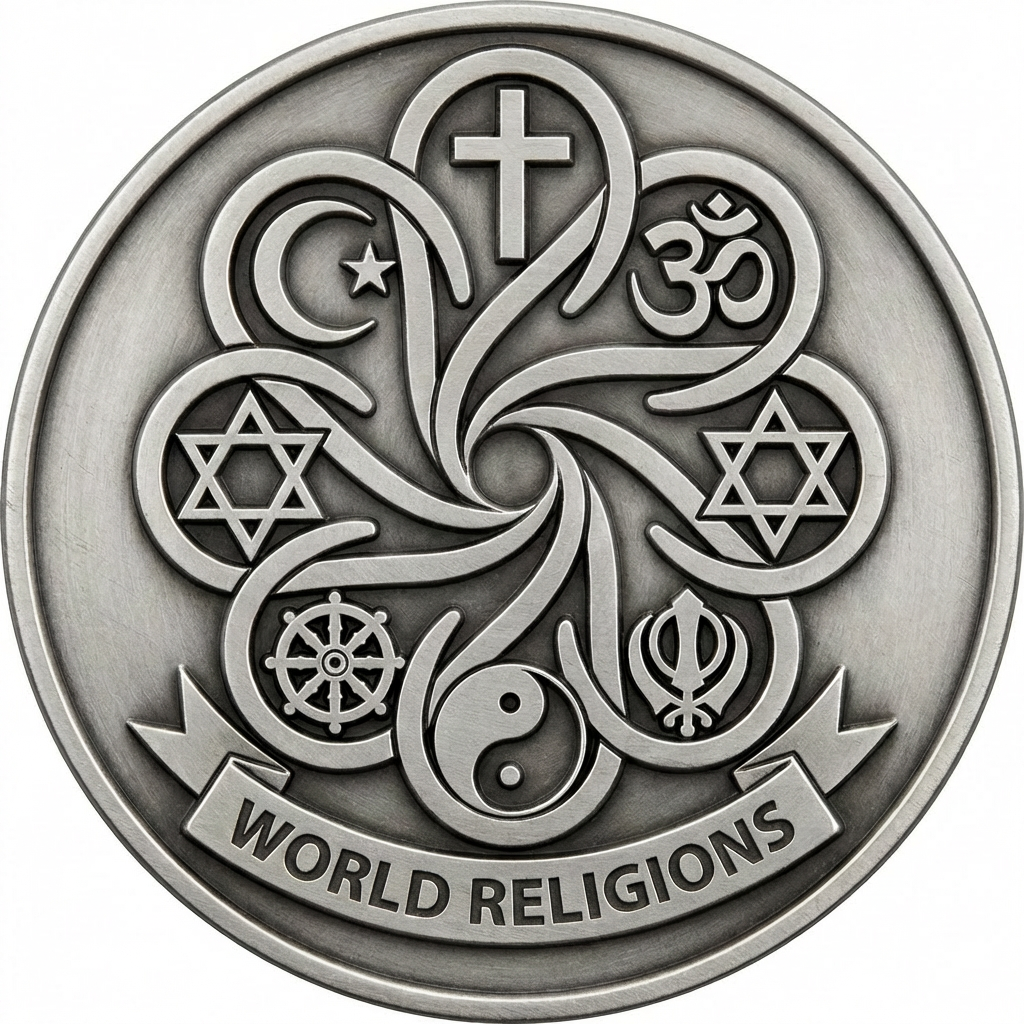
There are more than 4,000 religions practiced around the world today. Christianity has the largest following, with around 2.5 billion adherents, followed by Islam with 2.1 billion, Hinduism with 1.4 billion, and Buddhism with 520 million. Other significant faiths include Sikhism (30 million), Judaism (15 million), and the Bahá’í Faith (8 million). Folk and indigenous religions account for roughly 430 million people worldwide.
Read more: Revealed: He-Man in the Masters of the Universe is Lucifer
However, if you study these religions, you will notice that none of them directly leads you to the Creator of Heaven and Earth. This is because most of these religions did not exist in the beginning and were later created by the fallen angels, the very beings humans once worshipped as the old gods or Elohiyms.
Following their rebellion in heaven, these angels descended to Earth and established various religions, each of which was in accordance with the ethnicity, cultural traditions, and geographic location of the individuals they encountered.
Read more: Beware: Superman is actually the Fallen Angel Lucifer (Satan)
The truth is also evident in the meaning of the word religion. When broken down, “re” means “to introduce,” and “legion” means a “host of spiritual beings.” When combined, it translates to the Introduction of a host of spiritual beings.
What this means is that the majority of the world’s 8 billion people are unable to connect with the Creator because of the many religions created by the fallen angels. Religion has become one of the most powerful forces in human history, something many people live, breathe, and even die for.
How the Fallen Angels created the different types of modern religion
To understand the origin of religion, we must first examine what happened to the fallen angels before they became gods on earth. Before their rebellion, all ranks of angels once lived in peace as celestial beings, fully aligned with the Creator’s will.
Through shared harmony, they carried out their duties in accordance with His commands, worshipping Him and keeping the heavens in order. Each rank, from cherubim to seraphim to principalities, demonstrated obedience, unity, and purpose.
Lucifer (Helel), the chief of the cherubim, oversaw many angels, including notable figures such as Beelzebub, Azazel, and Abaddon/Apollyon. Together, they accounted for one-third of the heavenly host under his leadership.
Read more: Exposed: The Statue of Liberty in New York is the Image of Lucifer
Pride and jealousy eventually drove them to revolt, particularly over the creation of Adam, the first human. Enraged that humans would be subject to God’s authority on Earth, their ambition drove them to defy the Creator. This combination sparked a cosmic war, after which God expelled the rebellious angels to the earth.
Interestingly, many ancient texts such as the Sumerian tablets refer to them as the Anunnaki, meaning “those who came from the heavens.” Similarly, the Book of Enoch tells the story of the Watchers, who came to Earth, taught forbidden knowledge, and misled humans away from the Creator.
The ultimate goal of the fallen angels was to keep humans from having a direct relationship with the Creator. Because of this, they went to different regions, pretended to be gods by using different names, and tricked people into following false devotional systems. Their influence led to the emergence of modern religion.
Read more: Revealed: Kneeling to Propose to a Woman originated from Babylon
When you think carefully, you will see that every religion, including Christianity, Islam, and others, has a central figure as a point of contact that claims to lead one to God. I will use the main figure in these religions to explain more.
Christianity
The prophets of the Bible were not Christians. The descendants of Seth worshipped only the Creator, and after the Great Flood, Shem passed this tradition down to Abraham, Isaac, and Jacob.
After the Messiah’s death and resurrection, His disciples preached Creator-centered worship. Outsiders, many of whom practiced paganism, noticed these disciples in Antioch and began calling them “Christians,” even though the followers themselves did not use the term.
Read more: Revealed: Jesus Christ Did Not Die on The Cross
When you look up the definition of the word Christian, you’ll see that “Christ” refers to the central figure introduced as the focal point of worship, whereas “-ianity” refers to a group or system. Together, they can be interpreted as a system built around devotion to a symbolic figure.
Before the cross, the earliest symbol used to represent Christianity was the fish symbolism known as the Ichthys. This symbol was used to reference Dagon, the Babylonian fish god. After the reign of the Queen of Heaven, he was highly revered in Babylon.

Dagon is among the fallen angels who, because of their part in corrupting humanity before the flood, were condemned to dwell at the bottom of the ocean. The kingdom they created was called Atlantis. He and many of his brethren were said to have slept with human women, which gave rise to the Nephilim giants.
The females who associated with Dagon and the rest of the fallen angels were also cast to the ocean as sirens. In the movie Aquaman, Hollywood even revealed Dagon to be Arthur Curry, the real heir to the Atlantean throne.

According to a breakdown of his name, “dag” means fish, and “-on” means lord or great one, making him the “Fish Lord.” In many cultures, he has been known by various names, including Neptune, the god of the sea or Poseidon.

When Emperor Constantine made Christianity the state religion of the Roman Empire, he combined it with Babylonian paganism, thereby adding many of its practices such as Sunday worship and holidays like Christmas and Easter.
By putting Jesus at the center, Constantine established the idea that salvation required devotion to a human figure, thereby solidifying Christianity as the dominant faith system.
Read more: Exposed: Balenciaga Designer was created to Honor Baal (Satan)
As time went by, Christianity became a state religion used to terrorize populations, as seen in the Crusades, which sought to reclaim the Holy Land from Muslims, the Albigensian Crusade, which targeted the Cathars in southern France, and the Inquisition, which tortured and executed thousands accused of heresy.

During the colonial period, Christianity justified African enslavement and oppression of Black communities in the Americas. Millions of people were forced into brutal labour under the guise of spreading the “true faith,” and centuries later, the same Christianity was used to impose social hierarchies, discrimination, and fear.
In essence, the fallen angels created Christianity to replace direct worship of the Creator with devotion to Jesus, a human figure raised to divine status. Because of the fallen angels’ influence, many Christians believe Jesus is God.
Islam
Just as the angel Gabriel appeared to Mary to announce the birth of Jesus, he is said to have visited the prophet Mohammed in the Cave of Hira. This interpretation is according to Islam.
The fallen angels used the same deception by using the name, Gabriel, in both Christianity and Islam to link the stories of Jesus and Mohammed. By including a familiar and trusted messenger of God in both accounts, the Christian and Islamic authors were able to make the narratives appear authentic.
Although the Quran is regarded as the inspired word of Allah, the Creator is not truly known by that name. This is because no one, not even the highest-ranking celestials, knows the Creator’s name.
The term “Allah” is a combination of “Al,” which means “the,” and “ilah,” which means “god” or “divine being,” literally translating to “the God.” Given that the term “god” has no implied meaning, many Muslims, and scholars, have refused to ask which god Allah refers to.
Like Christianity, Islam has been linked to violence. Over the past 1,400 years, jihad-related conflicts may have killed up to 270 million people. Between 1979 and 2024, Islamist terrorist attacks killed approximately 250,000 people, with 19,109 deaths reported in Africa alone in 2022.
Must Read: Revealed: The Meaning of “Ham saw his father nakedness”
The bigger picture is that the Creator would never send angels to teach humans how to establish religions. If an angel directs a human to start a religion, it is far more likely acting on its agenda. And one way this agenda manifests itself is through the use of symbols. A clear example is Islam’s holy site, the Kaaba in Mecca.
The word “Kaaba” is derived from an Arabic root that means “cube” or “raised square structure,” referring to its shape. Cubes have symbolic significance in many cultures.

For example, the hexagonal storm at Saturn’s North Pole has six sides and becomes a cube when extended into three dimensions. Saturn, an ancient Roman god, is frequently associated with the cube in symbolic systems. Because the gods of the ancient world were fallen angels, Saturn represents Satan.
When Allah (god) and Kaaba (cube) are combined, the idea of a “cube god” is created. This is similar to modern Judaism, in which black cube symbolism is associated with celestial influence.
Read more: Exposed: The Reason White People Hate Black People is in the Bible
Just as Judaism emphasizes Saturday (Saturn Day), Islam uses the cube and related symbolism to shift attention away from the Creator and toward intermediaries of worship.
Judaism
Modern Judaism, as practiced today, is very different from the faith of the biblical Israelites. The Creator never told us to hide His name behind symbols. However, much of modern Judaism revolves around symbols related to fallen angels.
One of the most prominent of these symbols is the six-pointed hexagram, commonly known as the Star of David. Contrary to popular belief, this star has no connection to King David of the Bible.
Occultists incorporated it when modern Israel was founded. The star, made up of two interlocking triangles that form upright and inverted pyramids, represents fallen angel symbolism, as angels were once known as “stars” in the heavenly realm.

The star consists of two interlocking triangles that form two pyramids, one upright and one inverted.

As many of you are aware, the pyramids have long been associated with esoteric worship, such as the Baphomet satanic image and the hexagram, a six-pointed star connected, symbolically linked to Satan. These symbols have been used to give modern Judaism an aura of holiness, even though it is a religion created by fallen angels to create a global deception.

Modern Judaism’s doctrines and practices also show evidence of fallen angel influence. Mystical traditions such as Kabbalah prioritize secret knowledge and numerology.
Hinduism
Hinduism is one of the oldest religions, developed over centuries without a single founder. The main gods of Hinduism, such as Brahma, Vishnu, and Shiva, as well as avatars such as Krishna and Rama, are actually fallen angels.

Hinduism was created with multiple figures and aliases to direct people’s attention away from the Creator and toward fallen angels worship. This strategy is similar to how Jesus and Mohammed are central figures in Christianity and Islam.
Hinduism places a high value on symbols, rituals, and idols. Structured worship systems are formed by sacred geometry, the Om, the lotus, yantras, temples, offerings, mantras, and festivals. Devotees focus on statues of gods or avatars because they believe they contain divine power. Concepts such as karma and reincarnation teach people to focus on cycles and consequences.
Read more: Exposed: The Image on Starbucks is the Babylonian Queen of Heaven
These systems give the impression of divine order while gradually shifting focus to intermediaries, mystical knowledge, and human authority. Ideas like reincarnation and karma teach people to concentrate on cycles and outcomes, which strengthens their reliance on the system.
The number of people who practice Hinduism today demonstrates why this religion was founded. If 1.4 billion people today can practice Hinduism, it demonstrates the harm that the fallen angels have caused to humanity.
Buddhism
Buddhism is centered on Siddhārtha Gautama, the Buddha, who is considered an enlightened teacher. While he appears to be the religion’s central figure, the system was most likely created by fallen angels using him as a human intermediary. They kept their identities hidden by putting a mortal in the spotlight and directing human worship with structured teachings, symbols, and rituals.

Buddhism is practiced throughout Asia, including China, Japan, Thailand, Sri Lanka, and Myanmar. Devotional practices include meditation, chanting, offerings, temple visits, and adherence to moral precepts.
Read more: Revealed: The Term “Lord” refers to Baal (Satan)
Followers often focus on statues of the Buddha or Bodhisattvas, believing that these figures represent spiritual power. In addition to the Buddha, numerous Bodhisattvas and other spiritual figures, such as Avalokiteshvara, Manjushri, Amitabha, and Vairocana, act as intermediaries.
Conclusion
When you look closely at human history, you can’t help but notice one pattern: humanity has always desired someone or something to follow in its pursuit of spiritual truth. This desire is not new; it has existed among Adam’s descendants since the beginning. Humans have a natural desire to seek guides, leaders, prophets, teachers, and heroes who can help them understand the unknown world.
The bigger picture, therefore, is not simply the existence of thousands of religions, but the question of where those religions ultimately lead. If Jesus were removed from Christianity, would Christianity remain the same? If Muhammad did not exist, would Islam survive in its current form? Almost every major religious tradition raises similar questions.
The Creator does not hide Himself behind systems, institutions, or false spiritual paths. He responds to those who earnestly seek Him. When someone comes to Him with an open heart, they can feel His presence, guidance, and peace.
Through the disclosure contained within this article, you have been forewarned.
References
- Bottero, J. (2001). Religion in Ancient Mesopotamia. University of Chicago Press.
- Britannica Editors. (2024). List of religious populations. Encyclopaedia Britannica. https://www.britannica.com/topic/List-of-religious-populations
- Flood, G. (1996). An Introduction to Hinduism. Cambridge University Press.
- MacCulloch, D. (2010). Christianity: The First Three Thousand Years. Viking.
- Peters, F. E. (1994). The Hajj: The Muslim Pilgrimage to Mecca and the Holy Places. Princeton University Press.
- Pew Research Center. (2012). The Global Religious Landscape. https://www.pewresearch.org/religion/2012/12/18/global-religious-landscape-exec/
- Pew Research Center. (2017). The Changing Global Religious Landscape. https://www.pewresearch.org/religion/2017/04/05/the-changing-global-religious-landscape/
- Pew Research Center. (2025). How the Global Religious Landscape Changed from 2010 to 2020. https://www.pewresearch.org/religion/2025/06/09/how-the-global-religious-landscape-changed-from-2010-to-2020/
- Scholem, G. (1995). Kabbalah. Meridian.
- The Holy Bible, New International Version. (2011). Zondervan. Specific verses: Ezekiel 28:14; Revelation 12:4; Matthew 12:24; Luke 11:15.
- Islam grows, Christianity slips as share of world population, survey finds. (2025, June 9). Washington Post. https://www.washingtonpost.com/world/2025/06/09/islam-christianity-global-population-pew-survey/
- The Book of Enoch (apocryphal text). Hendrickson Publishers.


Leave a Reply