
Everything we see and hear today often has an origin behind it. One example is the title “Lord,” which is frequently used in biblical and Christian tradition to refer to God or Jesus, as well as in social and political contexts such as the British monarchy, to refer to people of high rank.
Many Christians make the grave mistake of reading the word as a direct reference to God. What they don’t realize is that the term Lord was used to refer to a deity during the biblical era.
Read more: Exposed: The Statue of Liberty in New York is the Image of Lucifer
Throughout the ages before Christianity, this deity has been deceiving the world into believing that it is the Creator, when in reality, it is not. In this article, I will expose the deity referred to as the Lord and how it was incorporated into the modern Bible.
The True Meaning of the Term “Lord”
According to the Book of Genesis Chapter 10, also known as the “Table of Nations,” humanity evolves from Noah’s three sons, Shem, Ham, and Japheth, after the flood.
Canaan, the son of Ham, is presented in the biblical genealogies as the ancestor of the peoples who later inhabited the land of Canaan, the region of the Levant. And one of the most important deities in their religious system was Baal.
The word Baal is derived from a Semitic root (b-ʿ-l), which represents the god of authority. From this root came the term “Lord” which was originally used to describe Baal.

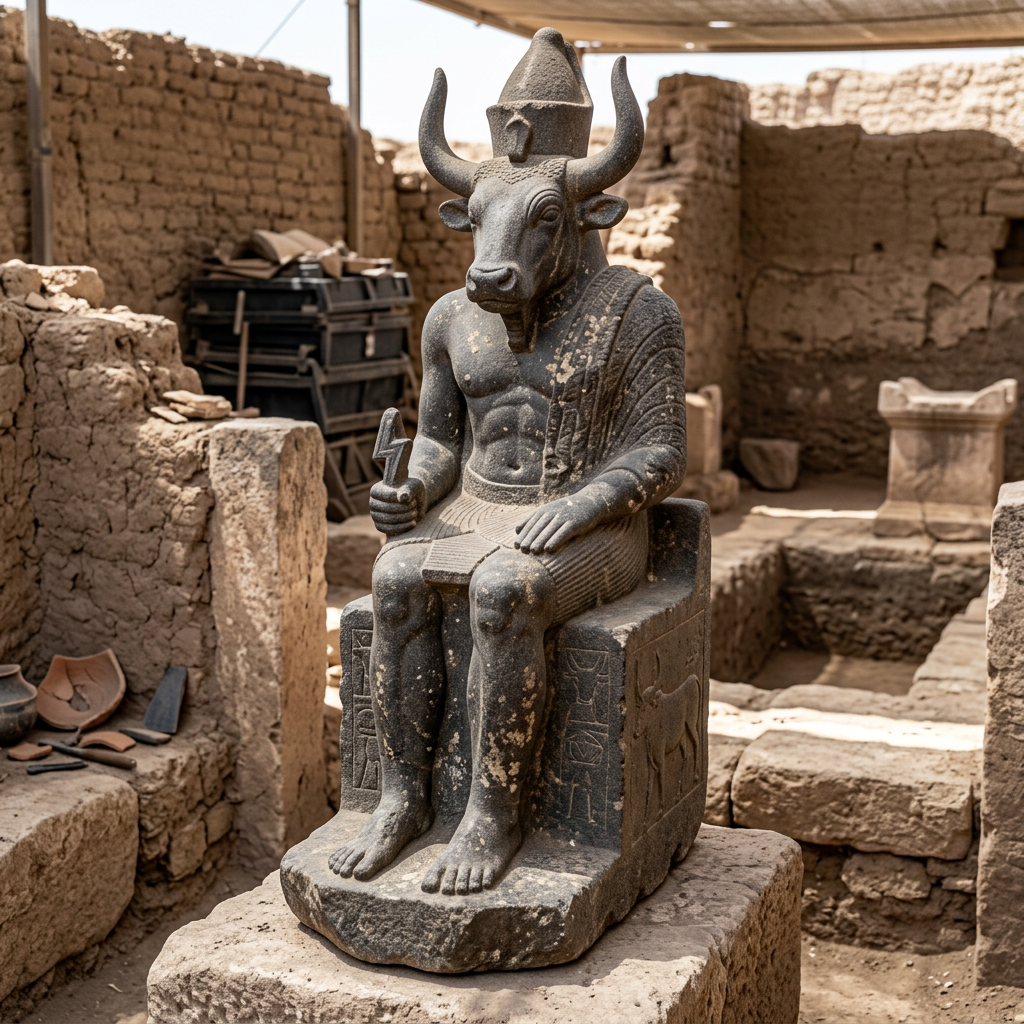
Baal was constantly portrayed as one of the deities the Creator forbids his people from worshipping, and he is always shown a bull symbolism. This same bull image can be seen in the golden calf that the Israelites made at Mount Sinai after leaving Egypt (Exodus 32).
Read more: Revealed: Kneeling to Propose to a Woman originated from Babylon
According to some biblical texts, child sacrifice is one of the Canaanite religious rituals connected to Baal worship. The purpose of these rituals is to attract wealth or divine favour (Jeremiah 19:5, Psalm 106:37–38).

Baal worship was not limited to the Canaanites; it was also practiced by many neighbouring countries in the ancient Near East. Among them were the Phoenicians, who descended from the same Canaanite stock and ruled Tyre and Sidon on the Mediterranean coast. They expanded Baal worship, honouring him with names like Baal of Tyre and Baal Shamem (“Lord of the Heavens”).
The Moabites, whose religion was similar, also worshipped Baal. Though their chief national god was Chemosh, they also extended their worship to Baal-peor, a local manifestation of Baal (Numbers 25:3).
Read more: Exposed: The Image on Starbucks is the Babylonian Queen of Heaven
Another nation who worshipped Baal were the Arameans, who lived in the northern regions. Their chief storm deity was Hadad, who was frequently associated with the title Baal, resulting in the figure known as Baal-Hadad. Even the Ammonites, who are best known for their worship of Milcom and Molech, retained some devotion to Baal.
The ancient Israelites, in particular, also became involved with Baal over time, largely because they lived in the same region and were continually exposed to surrounding Canaanite religious practices.
A notable example is King Ahab’s reign, during which Baal worship received royal support through his marriage to Jezebel, a Phoenician princess from Sidon (1 Kings 16:31-33 and 1 Kings 18:19).
Read more: The Dark History of Santa Claus and Why Christians Shouldn’t Celebrate Christmas
Even after Ahab’s reign, the book of Judges 10:6 described how the ancient Israelites continued to worship Baal (Hosea 2:13). This gave rise to the Hebrew term Adonai, which is a grammatical development of the word Adon, which means My Lord or Our Lord, and is another reference to Baal.
Over time, the word “Baal” was used as a title to replace YHWH. It wasn’t originally intended to be worship of the Canaanite god, as people used it in the same way that we say “my Lord” as a sign of respect in reading and prayer.
The problem was that it made the relationship between the Canaanite Baals and YHWH less clear. So, when the ancient Israelites referred to YHWH as “my Baal,” it appeared that they were placing Him alongside those other gods.
Read more: Revealed: He-Man in the Masters of the Universe is Lucifer
This explains why our Creator was displeased that His people had replaced His name with the title Baal (Hosea 2:16-17, Jeremiah 23:27, Jeremiah 12:16). He wanted His people to stop using that title so they wouldn’t mistake Him for the pagan god.
As Christianity spread across the Anglo-Saxon world, monastic scholars began translating Latin biblical texts into Old English for educational and religious purposes. These monastic translators used an English equivalent for the Latin Dominus and the Greek Kyrios, both of which were used to express lordship.
In earlier stages of transmission, Hebrew and Aramaic texts had been translated into Greek, where the term Kyrios (κύριος) became the standard word for Lord. When these texts were translated into Latin, Dominus was substituted for Kyrios in the Latin Bible.
The monastic translators also used the Old English word hlāford, which later became the modern English word “Lord,” to translate both Dominus and Kyrios in biblical texts.
Read more: Exposed: Ramen Noodle was named in Honor of Amun-Ra (Baal)
This is how the term “Lord” came to replace our Creator’s name in the standard English translation used in the modern Bible versions. Although it is being experienced by different generations, the truth is that it is the same old thing.
Conclusion
Baal worship is still happening right in our faces. For example, the designer Balenciaga, whose name derives from the Sumerian word Baal-Enki-aga, refers to the same Lord. The literal version is as follows:
- Baal = Lord in Canaanite
- Enki = Lord of the earth Sumerian
- Aga = Lord, master, older brother in Turkic/Persian
Overall, Balenciaga is a reference to Baal because all three names are linked to him in three different cultures: Sumerian, Persian, and Canaanite.
Read more: Exposed: Balenciaga Designer was created to Honor Baal (Satan)
Again, to prove my point, there are over 80 references in the Bible where the Creator condemns Baal worship and how it has replaced his name. The strongest condemnations are found in Jeremiah and Hosea, with the clearest passage being Jeremiah 23:27.
27 They think the dreams they tell one another will make my people forget my name, just as their ancestors forgot my name through Baal worship.
Jeremiah 23:27
Keeping this in mind, when your favorite pastor, gospel singer, or other famous person uses the word “Lord,” they are actually talking about Baal, who rules this world.
Through the disclosure contained within this article, you have been forewarned.
References
- Bible Gateway. (n.d.). New International Version (NIV).https://www.biblegateway.com/versions/New-International-Version-NIV-Bible/
- Bible Gateway. (n.d.). King James Version (KJV).https://www.biblegateway.com/versions/King-James-Version-KJV-Bible/
- Brown, F., Driver, S. R., & Briggs, C. A. (n.d.). The Brown-Driver-Briggs Hebrew and English lexicon. Bible Hub. https://biblehub.com/hebrewlexicon/
- Koehler, L., & Baumgartner, W. (n.d.). Hebrew and Aramaic lexicon of the Old Testament (HALOT). StudyLight. https://www.studylight.org/lexicons/hebrew/
- Liddell, H. G., Scott, R., & Jones, H. S. (n.d.). A Greek-English lexicon (LSJ). Perseus Digital Library. https://www.perseus.tufts.edu/hopper/text?doc=Perseus%3Atext%3A1999.04.0057
- Baal. (n.d.). Encyclopaedia Britannica. https://www.britannica.com/topic/Baal-deityKyrios. (n.d.). Encyclopaedia Britannica. https://www.britannica.com/topic/Kyrios
- Old English language. (n.d.). Encyclopaedia Britannica. https://www.britannica.com/topic/Old-English-language
- Smith, M. S. (2002). The early history of God: Yahweh and the other deities in ancient Israel. Eerdmans. https://www.eerdmans.com/Products/Book/The-Early-History-of-God
- Day, J. (2000). Yahweh and the gods and goddesses of Canaan. Bloomsbury Publishing. https://www.bloomsbury.com/uk/yahweh-and-the-gods-and-goddesses-of-canaan-9780826468307/
- Barr, J. (1968). Comparative philology and the text of the Old Testament. Oxford University Press. https://global.oup.com/academic/product/comparative-philology-and-the-text-of-the-old-testament-9780198262261



Leave a Reply