
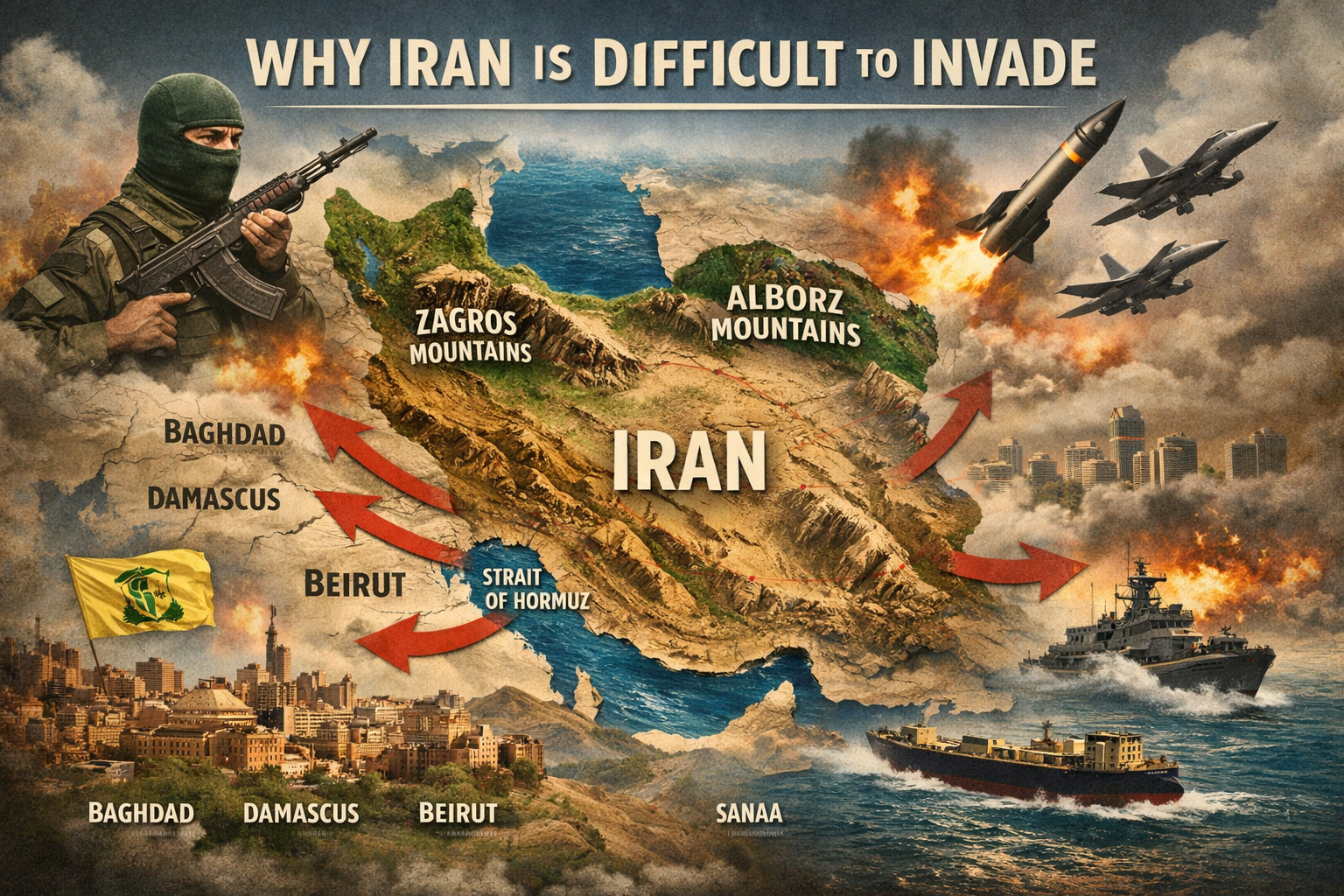
For many years, Iran has been at the center of geopolitical tensions involving Western powers and Middle Eastern rivals. Despite sanctions, military threats, and political pressure, no major power has attempted to invade the country recently. This is primarily due to Iran’s defensive posture, which is built on several strategic advantages, making any potential invasion extremely difficult and costly.
These advantages include Iran’s rugged geography, an asymmetric warfare-focused military strategy, and a network of regional alliances. These factors work together to create a system that intimidates outside powers by making the consequences of invasion far outweigh the potential gains.
To understand why Iran has been so difficult to invade, we must first examine the strategic foundations that have shaped the country’s defense and regional influence over the last few decades.
Geography: Iran’s Natural Defensive Advantage
One of the most important reasons Iran has proven difficult to invade is its geography. Iran is one of the Middle East’s largest countries, covering more than 1.6 million square kilometres. Its terrain is marked by rugged mountains, deserts, and long distances between major cities, all of which present significant challenges to any invading military force.
Iran’s natural defense relies heavily on two major mountain ranges. One is the Alborz Mountains, which stretch northward close to the Caspian Sea, and the other is the Zagros Mountains, which flow through the country’s western region. Since these mountainous areas act as natural barriers, it is challenging for big armies, tanks, and supply convoys to move swiftly. Historically, invading forces from both Western and regional empires found it difficult to manoeuvre through these terrains, often retreating or losing supplies.

Aside from mountains, Iran has vast deserts and long distances between major population centers. Maintaining supply lines through such terrain would be logistically difficult for any invading army. Even minor disruptions could cause operations to be delayed for weeks, allowing defenders to respond more effectively. Iran also controls strategic choke points such as the Strait of Hormuz, where even minor disruptions can have serious consequences for regional and global trade.
These natural barriers not only slow attackers but also allow Iranian forces to focus on key terrain and direct potential invaders in predictable directions, maximizing defensive effectiveness. As a result, geography is the primary line of defense in Iran’s overall strategy.
While Iran’s mountains, deserts, and strategic chokepoints make traditional invasions difficult, geography alone is insufficient. These natural advantages are reflected in the country’s military doctrine, which creates an impressive defense system.
Military Strategy: Iran’s Asymmetric Warfare Doctrine
Although Iran’s rough terrain serves as a natural defense, the military strategy of the nation is what really turns these advantages into a powerful barrier to entry. Instead of depending entirely on conventional armies, tanks, or fighter jets, Iran has created an asymmetric warfare philosophy that seeks to make invasion more costly while taking advantage of the vulnerabilities of more formidable enemies.
At the heart of this strategy is the Islamic Revolutionary Guard Corps (IRGC), a highly trained and politically influential branch of Iran’s armed forces. The IRGC works alongside Iran’s conventional military, focusing on regional influence operations, rapid response, and unconventional tactics. Its missions include missile strikes, drone operations, cyber capabilities, and naval threats, resulting in a multifaceted defense system.
Additionally, Iran’s asymmetric doctrine has a long history. During the 1980-88 Iran-Iraq War, Iranian forces used mountainous terrain, militia mobilization, and small-unit tactics to counter a larger, more technologically advanced Iraqi army. More recently, IRGC-backed militias in Iraq and Syria have shown that indirect tactics such as harassment, ambushes, and strategic targeting can be used to limit superior forces.
This strategy is reinforced even more by modern capabilities. Iran has made significant investments in ballistic missiles that can strike military bases, infrastructure, and strategic targets throughout the region. Moreover, they have drone programs that allow for precision strikes and reconnaissance, and naval swarm tactics in the Persian Gulf.
Iran’s unpredictability is further increased by its cyber operations, which have the potential to interfere with enemy communications, logistics, or vital infrastructure. When combined, they threaten chokepoints and shipping lanes, including the Strait of Hormuz, a vital route for the world’s energy trade.
Another important but often overlooked aspect of Iran’s defense is its leadership and command structure. Power is divided among several institutions, including:
- The Supreme Leader’s office
- The Islamic Revolutionary Guard Corps (IRGC)
- National security councils
- Intelligence agencies
Together, these institutions create redundancy within the chain of command, allowing the system to continue functioning even under prolonged military pressure. When central leadership is threatened, regional commanders can act independently, making rapid decapitation or collapse of the military and political systems extremely difficult. This layered leadership structure, combined with Iran’s terrain, asymmetric tactics, and dispersed infrastructure, serves as the foundation of the country’s overall deterrence strategy.
Many people fail to recognize that Iran’s goal is not to completely defeat an invading force, but rather to make any military campaign prohibitively expensive and strategically risky. After decades of planning, testing, and battlefield adaptation, Iran has developed a multilayered defense system designed to exhaust and deter potential adversaries.
Regional Influence: Extending Strategic Depth Through the Axis of Resistance
Iran’s defense strategy is significantly strengthened by a network of regional alliances and proxy groups known as the Axis of Resistance. Through the creation of several layers of deterrence, this framework expands Iran’s influence well beyond its boundaries, making direct military conflict much more difficult and uncertain. Key components of this network include:
- Lebanon: Hezbollah has demonstrated its military capability during the 2006 Lebanon War and continues to serve as a powerful deterrent along Israel’s northern frontier.
- Syria: Iranian support for the Syrian government and allied militias preserves a key strategic partner and maintains influence along a critical regional corridor.
- Iraq: Shia militias backed by Iran have demonstrated the ability to pressure foreign military forces and target supply lines, highlighting the effectiveness of indirect operations.
- Yemen: The Houthi movement provides strategic leverage in the Arabian Peninsula. Through missile and drone attacks, it can threaten regional infrastructure and key maritime routes.
These alliances provide Iran with strategic depth beyond its own borders. In the event of a major conflict, these partners could open additional fronts, disrupt infrastructure, or threaten supply lines, forcing adversaries to divide their military resources across multiple theatres. What might otherwise remain a localized confrontation could quickly escalate into a broader regional conflict.
Iran benefits politically and strategically from the Axis of Resistance. Iran can control regional dynamics while limiting the exposure of its conventional forces by extending its influence through regional partners rather than direct military engagement. This strategy complements Iran’s asymmetric military doctrine and contributes to a multi-layered defense system that combines geography, military capability, and regional influence.
Iran’s overall strategy emphasizes survival and suppression over direct battlefield dominance. Through the use of numerous, reasonably priced drones, missiles, and allied forces, Iran is able to force its enemies to invest a substantial amount of money in defending against recurrent attacks.
Strategic chokepoints such as the Strait of Hormuz raise the economic stakes even higher, implying that even technologically superior militaries may face lengthy, resource-intensive campaigns rather than quick and decisive wins.
Conclusion
The challenge of invading Iran cannot be explained by a single factor. Instead, it is the result of a multi-layered defense system influenced by geography, military doctrine, regional alliances, and modern warfare realities.
While Iran’s asymmetric military doctrine increases the operational cost of conflict, its vast and rugged terrain makes large-scale operations more difficult. The battlefield is further expanded well beyond its boundaries by its network of regional alliances.
When combined, these components create a complete deterrent. Any attempt to invade Iran would likely involve long-term engagements on multiple fronts, with significant economic and political consequences.
For these reasons, the decision to confront Iran militarily is about more than just capability; it is also about navigating a complex strategic system that makes such an undertaking extremely difficult, expensive, and uncertain.
When dealing with Iran, my advice is to use diplomacy because invading them would be a fatal mistake for any nation.
References
- Cordesman, A. H. (2020). Iranian military forces and warfighting capabilities: A strategic analysis. Center for Strategic and International Studies. https://www.csis.org/analysis/iranian-military-forces-and-warfighting-capabilities
- Katzman, K. (2023). Iran: Internal politics and U.S. policy and relations. Congressional Research Service. https://crsreports.congress.gov/product/pdf/R/R44017
- Pollack, K. M. (2004). The Persian puzzle: The conflict between Iran and America. Random House. https://www.randomhouse.com
- Cordesman, A. H., & Colley, A. (2022). Iran’s regional strategy and proxy networks: The Axis of Resistance. Center for Strategic and International Studies. https://www.csis.org/analysis/irans-regional-strategy-and-proxy-networks-axis-resistance
- Katzman, K. (2022). The Strait of Hormuz and Iran’s strategic influence. Congressional Research Service. https://crsreports.congress.gov/product/pdf/IN/IN11812
- Cole, J. M. (2018). Asymmetric warfare and the Islamic Revolutionary Guard Corps. RAND Corporation. https://www.rand.org/pubs/research_reports/RR2567.html
- Cordesman, A. H. (2021). Iranian defense strategy and military doctrine. Center for Strategic and International Studies. https://www.csis.org/analysis/iranian-defense-strategy-and-military-doctrine
Sources / Further Reading
- CIA World Factbook. (2024). Iran. https://www.cia.gov/the-world-factbook/countries/iran/
- Geopolitical Atlas. (2022). Iran Terrain Analysis. https://www.geopoliticalatlas.org/iran-terrain
- CSIS. (2023). Middle East Program. https://www.csis.org/programs/middle-east-program
- The Washington Institute. (2023). https://www.washingtoninstitute.org/
- Jane’s Defence. (2023). https://www.janes.com/
- Brookings. (2023). The Axis of Resistance. https://www.brookings.edu/
- Energy Information Administration. (2023). Strait of Hormuz Overview. https://www.eia.gov/international/regions-topics/strait-of-hormuz/
- BBC News. (2006). Hezbollah and the 2006 Lebanon War. https://www.bbc.com/news/world-middle-east-12345678



Leave a Reply