
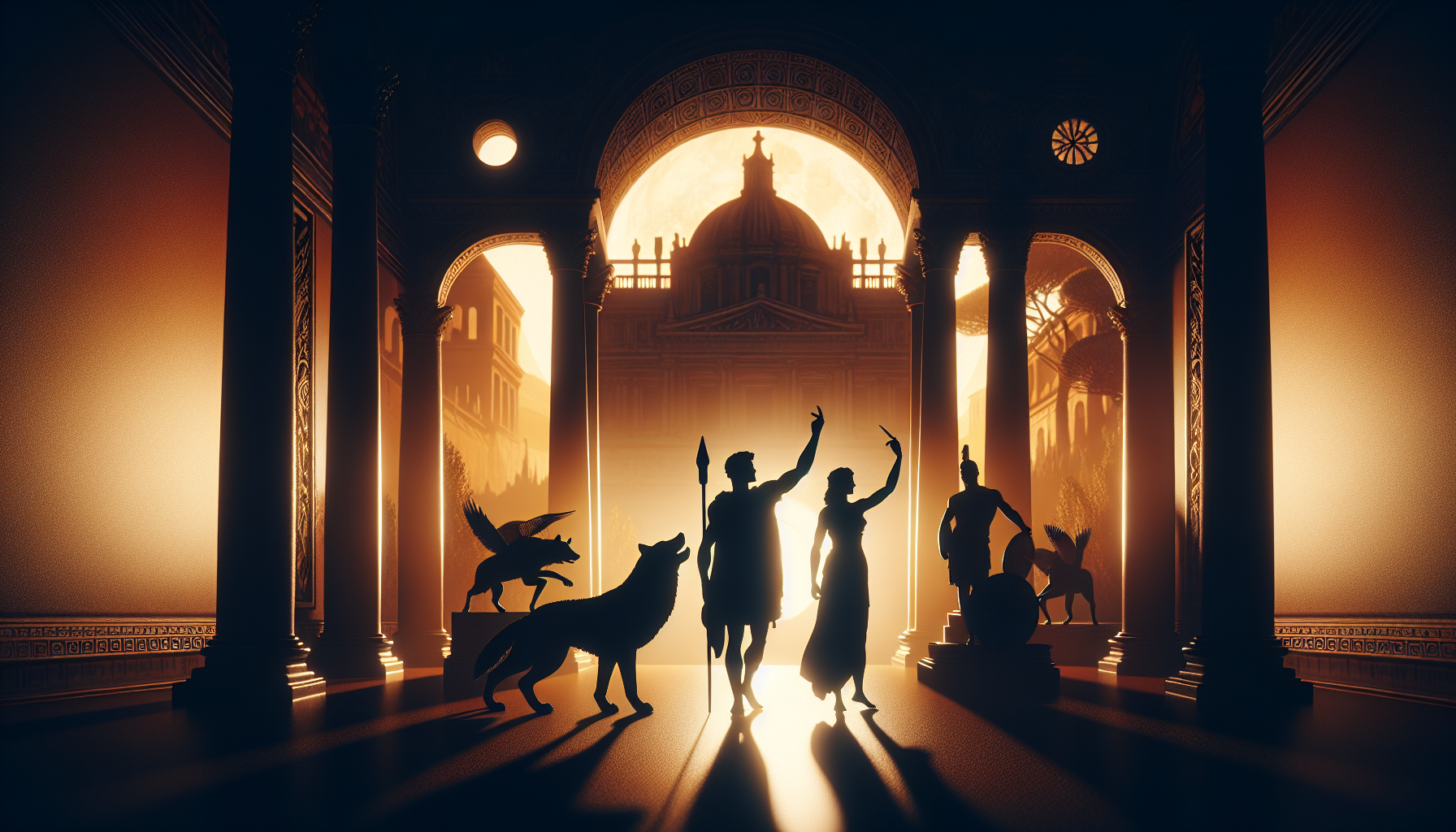
The Roman Empire’s lasting impact can be seen in many aspects of modern society, including law, politics, architecture, civil engineering, literature, the arts, and languages. The empire emerged in 27 BCE and flourished with Rome as its main center, profoundly influencing Europe, North Africa, and Western Asia.
Roman mythology, particularly the story of Romulus and Remus, is central to the empire’s history, recounting the events that led to Rome’s founding and subsequent rise.
The Legend of King Romulus and Remus
Rome’s mythological origins can be traced back to the ancient Latin city of Alba Longa. According to legend, the city was the founder and leader of the Latin League before being conquered by the Romans in the seventh century BC. The city is also thought to be the birthplace of the legendary twins Romulus and Remus.
According to Roman historian Titus Livius, Romulus and Remus were the sons of Rhea Silvia, who claimed to have been impregnated by Mars, the Roman god of warfare. The twins’ maternal grandfather was Alba Longa’s rightful king, Numitor. Numitor’s younger brother, Amulius, seized the throne and became king.
To prevent Numitor’s relatives from retaking the throne, Amulius executed Numitor’s sons and forced Rhea Silvia to become a Vestal Virgin. Despite this, Rhea Silvia became pregnant, so Amulius imprisoned her and had a servant drown the twins in the Tiber River, which carried them to a pool near the riverbank. They were raised and fed by a woodpecker and a she-wolf, two animals that are highly valued in Mars culture, until a herdsman named Faustulus found them.
The twins were raised by Faustulus and his wife, Acca Larentia, and went on to become the leaders of a group of young, daring individuals. In 752 BCE, they led a group of warriors in a successful attempt to depose Amulius, putting him to death and installing Numitor as the new king of Alba Longa. Romulus then built a wall around the Palatine Hill and settled there.
To find the ideal spot for their new city, the twins surveyed the seven nearby hills. The Palatine Hill was Romulus’s favorite, not Remus’s Aventine Hill. They turned to augury to settle their dispute, using omens they received from studying bird behaviour. However, the argument ended tragically when Romulus killed Remus.
Romulus was the only one to found Rome, and he gave the city his name. He laid the groundwork for the Roman Empire by founding the first Roman legion and the Roman Senate. Romulus was able to bring in people from all over Italy by offering refuge to exiles and fugitives. Given the city’s preponderance of men, Romulus had to come up with a plan for finding wives.
He invited the neighbouring Sabines to a celebration, during which Roman men kidnapped their women, an event known as the Rape of the Sabine Women. The Sabines, led by Titus Tatius, were initially hesitant to declare war on Rome, preferring to negotiate the release of their kidnapped women. However, after their diplomatic efforts were turned down, they mobilized their troops and marched toward Rome.
The Sabine women, who had developed close bonds with their Roman husbands, intervened, pleading for reconciliation. Hersilia, their leader, was instrumental in bringing about peace. Romulus and Titus Tatius readily agreed, bringing the battle to a halt and establishing a truce.
The Sabines were granted Roman citizenship, and the two nations formed a historic alliance. Titus Tatius accepted a shared kingship with Romulus, and a portion of the Sabine people stayed in Rome, assimilating into the Roman people. However, tensions arose when Titus Tatius’ acquaintances clashed with the inhabitants of Lavinium.
Titus Tatius’ acquaintances raided the town of Lavinium, stealing goods and livestock. The people of Lavinium demanded immediate justice, but Titus intervened, defying Romulus’ intention to enforce the law. The controversy over Titus’ decision outraged the people of Lavinium. They ambushed Titus at the altar, killing him instantly.
Read also: Revealed: The Romans and Europeans are descendants of Esau and Japheth
The news of Titus Tatius’ death deeply affected Romulus, who resolved to take action. Despite their disagreements about Lavinium, Romulus felt a sense of loss and outrage at the death of a Roman king. He insisted that the Lavinian assassins be tried in Rome.
After hearing their arguments, Romulus unexpectedly declared them not guilty, acknowledging their legitimate reasons for avenging the wrongs committed by Titus Tatius’ men. He ordered their release, which avenged Titus Tatius’ death but did not result in punishment.
The outcome left Romulus as the sole ruler of Rome, marking a watershed moment in the city’s history. What happened next would become a legendary story in Roman history, shaping the city’s future and cementing Romulus’ legacy as its founder and leader.
The Death of King Romulus and the various theories surrounding it
The circumstances of the death of Rome’s founder and first king, Romulus, have sparked intense debate among scholars. While most agree that he died at the age of 55, after a 37-year reign, there is no agreement on the cause of his death.
Theory 1: Murdered by the Roman Senators
One theory is that he was murdered by the Roman Senators. Romulus’ decisions and behaviour may have compromised Rome’s security, leading to discontent among the Roman senators. His triumph over Veii, a powerful Etruscan city, and his subsequent release of 50 hostages, undermined Rome’s international standing.
Furthermore, Romulus’ conquest of Alba Longa and subsequent transfer of authority to the Albans stood in stark contrast to his autocratic reign in Rome. The senators’ tolerance for Romulus’ rule was precipitated by his severity and cruelty as a judge.
According to certain historians, the senators plotted against Romulus because they were fed up with his tyrannical rule. An incident at the Temple of Vulcan might have been connected to his death.
Theory 2: Torn apart out of jealousy and Marginalization
The integration of defeated tribes, including the Sabines, into Roman society may have led to growing discontent among the Sabines. Romulus’ failure to punish the perpetrators of Tatius’ assassination may have contributed to the marginalization of the Sabines as second-class citizens. Eventually, some Sabine people may have put Romulus to death as a result of this mounting dissatisfaction.
Theory 3: Raised to heaven by the god of Mars
The Roman poet Publius Ovidius Naso presented a fantastical account of Romulus’ demise in his Metamorphoses. According to Ovid, Romulus was escorted to the heavens by his divine father, Mars, and became the god Quirinus.
While Ovid’s account was poetic, many Romans remained skeptical. However, Proculus Julius, a close associate of Romulus, came forward and claimed to have witnessed Romulus descending from the heavens briefly. After Romulus’s death, Rome underwent a peaceful transition, as this testimony was enough to put an end to any possible unrest
The Reign of Numa Pompilius and Lucius Tarquinius “Superbus”
Numa Pompilius, the second king of Rome, played a significant role in shaping the city’s religious and institutional framework. He’s credited with creating the Roman religious calendar, establishing the Vestal Virgins, and founding the cults of Mars, Jupiter, and Quirinius (Romulus deified). However, it’s likely that these innovations were the result of centuries of religious evolution, rather than solely Numa’s doing.
Numa’s calm demeanour was a stark contrast to that of his predecessor, Romulus, the more aggressive founder of Rome. Following Numa’s reign, five additional kings ruled Rome, culminating in Lucius Tarquinius Superbus (Tarquin the Proud). Tarquin’s despotic regime was marked by the murder of his predecessor, Tullius, and the killing of many senators.
The catalyst for the uprising against Tarquin was the rape of Lucretia, a noblewoman, by his son, Sextus. This event ultimately led to the expulsion of the Tarquin family from Rome and the abolition of the monarchy in 509 BCE.
Tarquin’s attempts to seek revenge against Rome were unsuccessful, and he was defeated at the Battle of Silva Arsia and later at Lake Regillus. The aftermath of these events marked the establishment of the Roman Republic in the sixth century BCE, ushering in a new era of governance and freedom for the city of Rome.
Sources
Cary (1978), Dionysius of Halicarnassus – The Roman Antiquities
Kline (2000), Ovid – Metamorphoses
Loeb Classical Library edition (1914), Plutarch – Parallel Lives: Life of Romulus
SPILLAN (2006), History of Rome



Leave a Reply to Explained: What caused the fall of the Roman Empire? – MakewetalknowCancel reply