
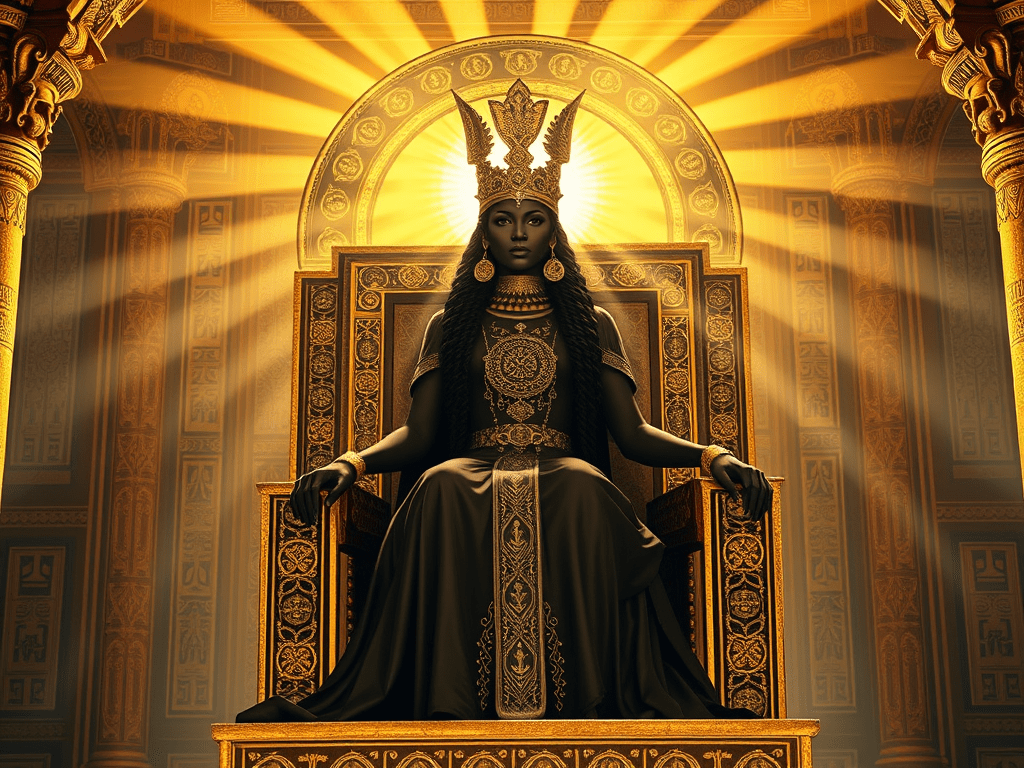
Paganism is believed to have originated early in human history. Nimrod, a descendant of Ham and son of Cush (Genesis 10:6-8), elevated pagan practices to new heights. It is important to note that Nimrod was regarded as the man who committed an abomination by marrying his own mother, Semiramis.
After king Nimrod died, Semiramis feared she would lose her significance. As a result, she made up a story about Nimrod appearing to her through a ray of sunlight and then impregnating her, giving birth to their son Tammuz. Furthermore, Semiramis also declared that after her death, she would ascend to the heavens to join her husband, Nimrod.
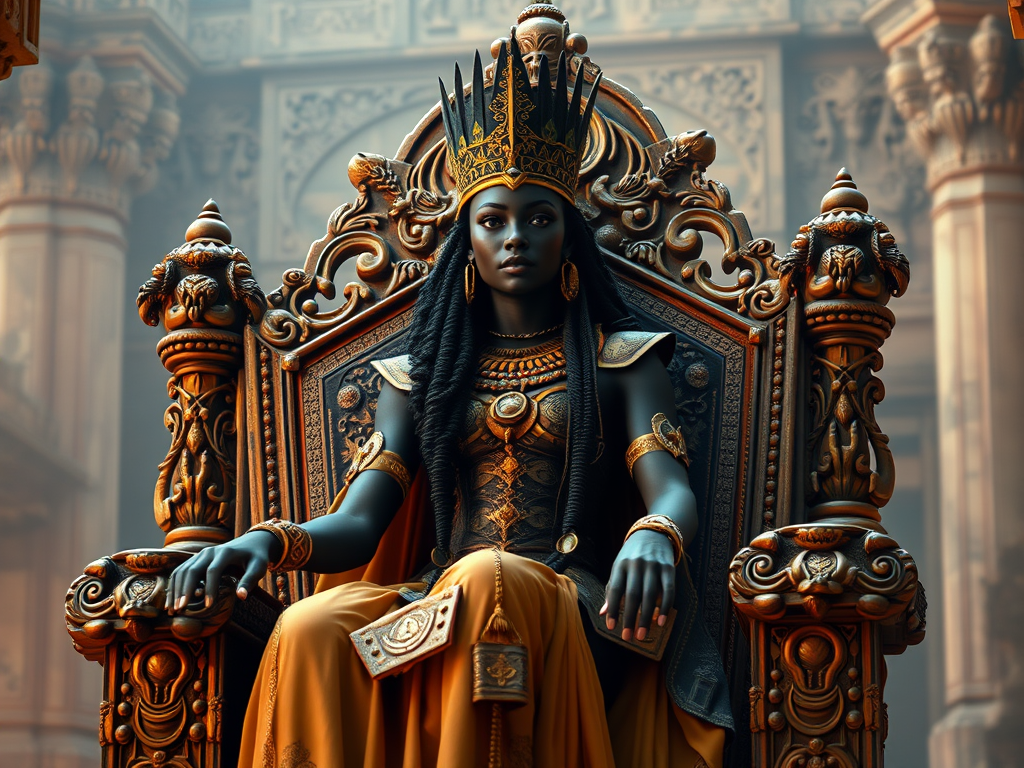
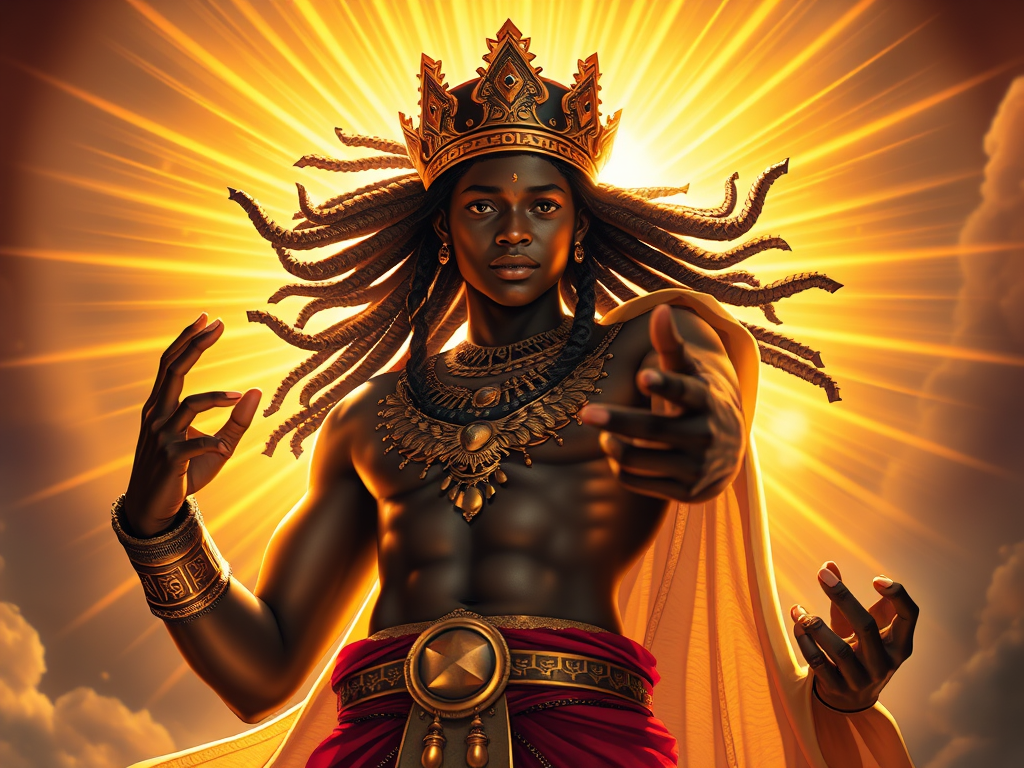
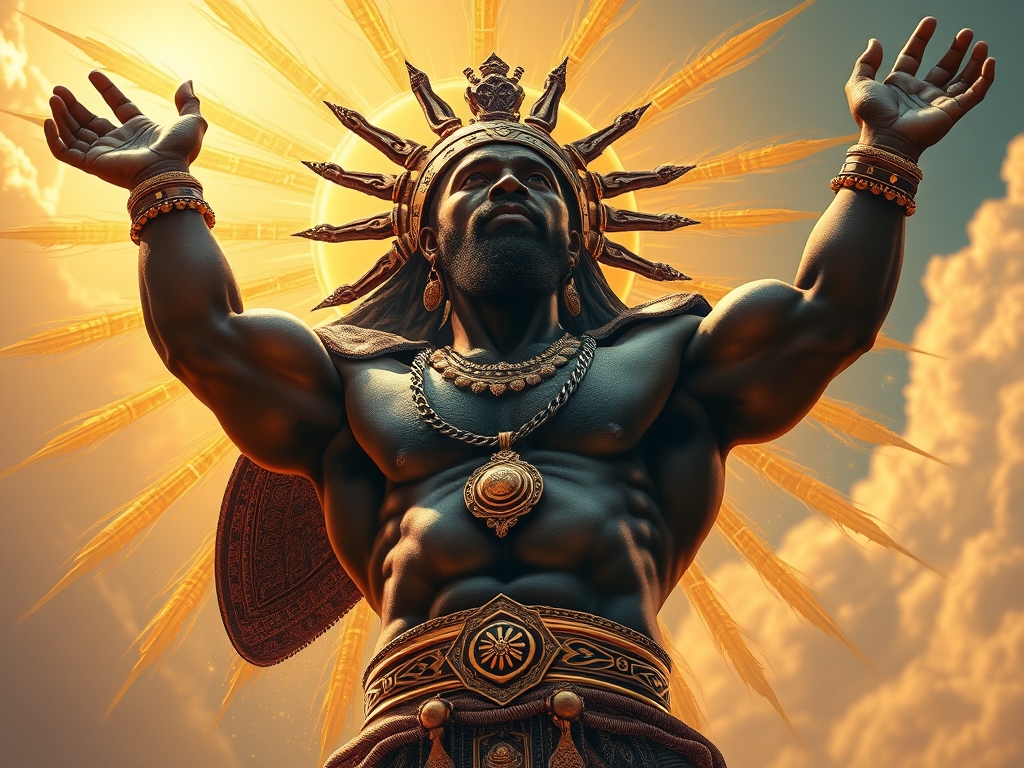
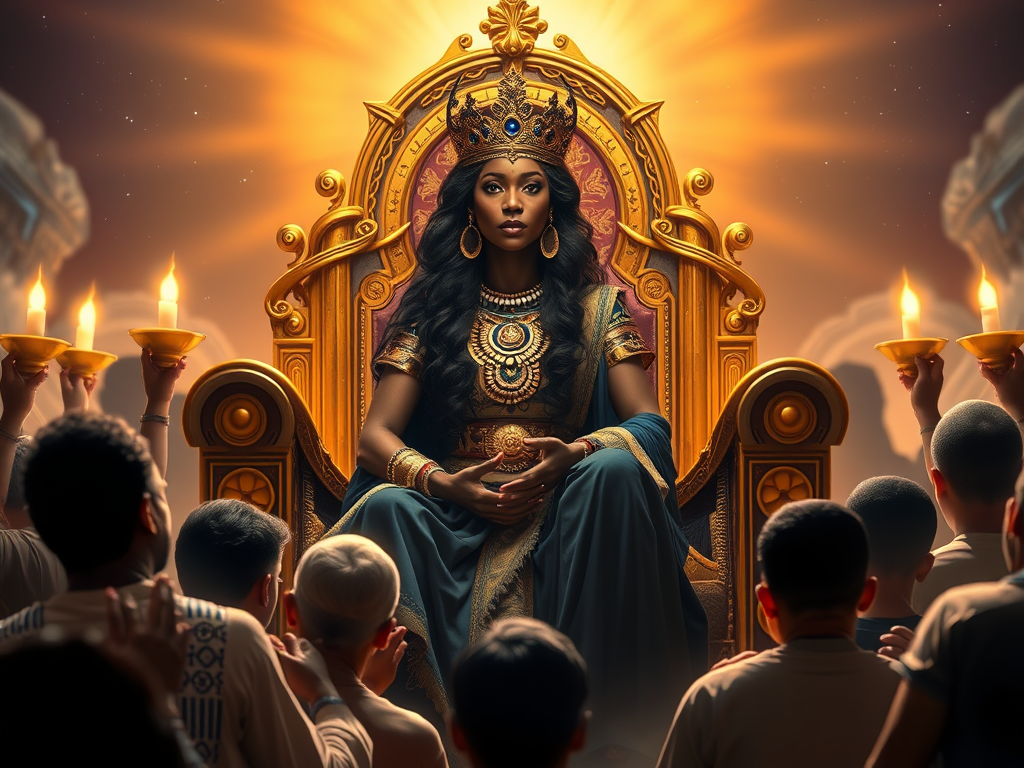
This led to her being referred to as the Queen of Heaven (Ishtar), a title mentioned in Jeremiah 7:18 and Jeremiah 44:17–25. Her son Tammuz was also referred to as the Sun of God, inheriting the title from his father, Nimrod, who was the Sun God. The trio came to be known as the Holy Family symbol.
In her honor, graven images of a mother holding her child, were erected throughout Babylon. Worshippers held ceremonies in her honor, and women would imitate her during prayers. It was during her procession that the tradition of proposing love while kneeling and holding a ring began.
Her priests were known to carry Ishtar statues and use incense during rituals. Worshippers seeking her blessings would kneel before her throne and present her with rings and neckless as proof of their love for her. Before presenting these gifts, a worshipper must first confess their sins to her.
In honor of her husband, the Sun god Nimrod, processions were also held in the afternoons, during which worshippers would dance in the sun. This is where the origin of the sun dance came from. This was a customary ritual that was performed throughout Babylon to appease the Queen of Heaven, Ishtar, for her to bless the congregation.
Her cult worship became popular and spread throughout the world, eventually reaching us through Rome. Rev. Alexander Hislop proved this claim in his book, The Two Babylons, where he wrote that Semiramis (Ishtar) and Tammuz mother and child worship became a worldwide phenomenon.
| Mother | Son |
|---|---|
| SEMIRAMIS (Babylon) | Tammuz (Babylon) |
| Cybele, Goddess Mother (Asia) | Deoius (Asia) |
| Fortuna (Rome) | Boy Jupiter (Rome) |
| Isis (Egypt) | Osiris (Egypt) |
| Isi, Goddess Mother (India) | Iswara (India) |
| Venus (Rome) | Cupid (Rome) |
| Ashterath (Phoenicia) | Tammuz (Phoenicia) |
| Aphrodite (Greece) | Eros (Greece) |
| Irene, Goddess of Peace (Greece) | Boy Plutus (Greece) |
Nimrod, Tammuz, and Semiramis were known in Egyptian mythology as Osiris, Horus, and Isis, respectively. In ancient Greek mythology, Semiramis and Tammuz were worshipped as Aphrodite, the goddess of love, and Eros.
Semiramis was worshipped as Venus in ancient Roman mythology, while Tammuz was Cupid, her son and husband. According to Hindu mythology, Semiramis and Tammuz were revered as Krishna’s divine avatar and Devaki’s beloved son. In Chinese mythology, Semiramis was also known as Shing Moo, or “the Holy Mother.”
How Emperor Constantine Brought Semiramis Worship into the Catholic Church
When the Persians conquered Babylon in 539 BCE, Semiramis’ priest brought her cult to Rome, where Emperor Constantine became interested in it. Even before that, Constantine was seeking to unite various pagan groups into Christianity. He believed that instead of having multiple religions, humans should have one under a single religion.
Read more: Worshipping the Queen of Heaven (Virgin Mary) is a Sin against God
At the First Council of Nicaea, he proposed incorporating all pagan practices into Catholicism to encourage more pagan conversion to Christianity. This brought all of Semiramis’ teachings to Rome, including her Ishtar festival, which reinterpreted Nimrod’s resurrection as Tammuz. The festival’s name came from her Babylonian title, Ishtar, which was later misspelled as Easter.
Semiramis’ sun worship evolved into a Roman icon, influencing Catholic art with symbols like sacred chalices and halos that represent the sun. Her name was also used to create the “seminary,” which is a training facility for Catholic priests.
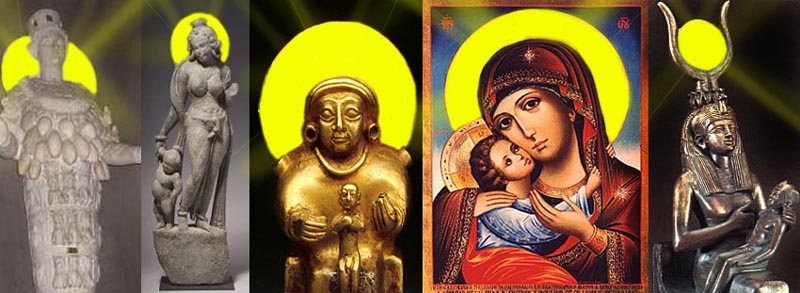
Furthermore, she also influenced the expansion of the Trinitarian doctrine in Catholic theology, which is represented by Nimrod (Sun god), Semiramis (Queen of Heaven), and Tammuz (Sun of God). Later, this system would be copied by the early Catholic Church heirachy, who would rename the trio as Mary, Jesus, and Joseph.
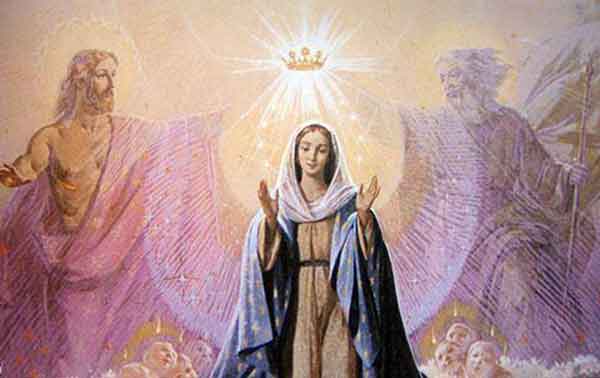
This counterfeit religion paved the way for other Roman Catholic practices such as confessing sins to the priest, whereas the Babylonians were known to confess their sins to the queen of heaven, Semiramis, who would declare them sin-free. Even though the Bible forbids confessing sins to another man, the Roman Catholic Church incorporated this act from the Semiramis religion and made it part of its doctrine. (1 Timothy 2:5, Luke 5:20-21).
More Connection Between Babylonian System of Worship and Catholicism
The Babylonian system of worship and Catholicism share many similarities, but one that stands out is their use of the cross symbol. The cross symbol, which is still widely used by Catholics and Christians today, originated in Babylon.
Emperor Constantine was responsible for incorporating the cross into Christianity and Catholicism after claiming to have seen a vision before the Battle of Milvian Bridge in 312. He claimed to have seen a cross in the sky with the words ‘In hoc signo vinces’ (‘In this sign, you will conquer‘), which marked a watershed moment for Christianity.
Following the Milvian Bridge War, Constantine adopted the cross as a symbol, first for military campaigns, then for Christianity. This is why you see the same cross symbol used in so many conquest battles across Europe.
Before the Battle of the Milvian Bridge, the cross symbol was already used in Babylon. The Tau cross (T-shape) was a symbol of Tammuz’s worship as the sun god, which was represented by the cross symbol. His worship included fertility ceremonies, life cycle events, sacred marriage rites, and funeral and resurrection rituals.

Many scholars believe Constantine may have lied about seeing the cross in the sky to consolidate power in a crumbling Rome, bringing Babylon into Rome and uniting the empire under a single faith.
In general, Constantine approved the addition of halo symbolism, Marian devotion, the sign of the cross, clergy confession, and incense use, all of which originated in Babylon. Pagan holidays such as Christmas, Lent, and Easter were also incorporated. In reality, Constantine introduced Babylon to Rome.
Read more: Exposed: Jesus Christ Did Not Die on The Cross
Satan intended to deceive future generations by making us worship Babylon all over again. Even his name is written all over the place where its seat of power is located. The term “Vatican” comes from the Latin words “vatis” (prophet) and “can” (snake or serpent), implying a connection to serpent worship. In addition, the headquarters of the Catholic Church even bears witness to Satan’s image in its architecture. The Paul VI Audience Hall is designed to resemble a serpent.

The Paul VI Audience Hall, also known as the Hall of the Pontifical Audiences, is a well-known building in Rome named after Pope Paul VI. The hall, designed by renowned Italian architect Pier Luigi Nervi, was completed in 1971 and has a seating capacity of up to 6,300.
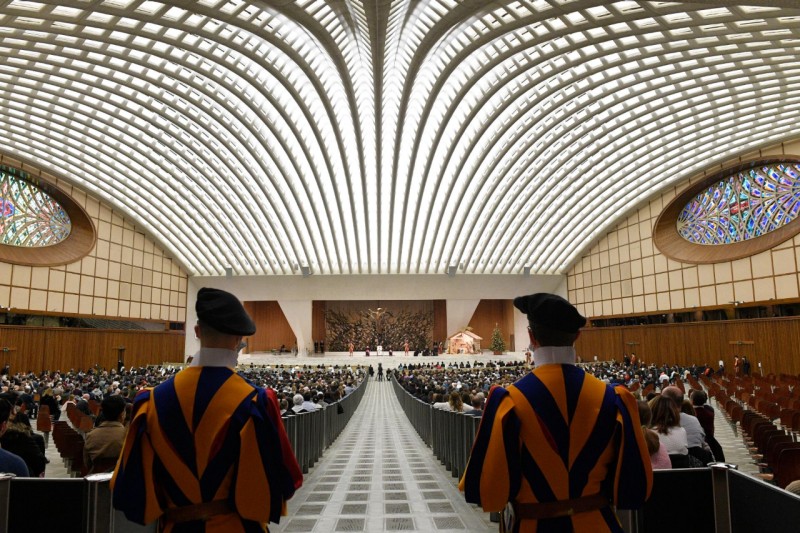
The Paul VI Audience Hall’s interior design contains intriguing symbolism, particularly in the windows, which resemble a massive reptilian face with intricate details that mimic reptile skin and fangs. Every aspect of the design, from the textured skin to the fangs, appears to send a deliberate message.
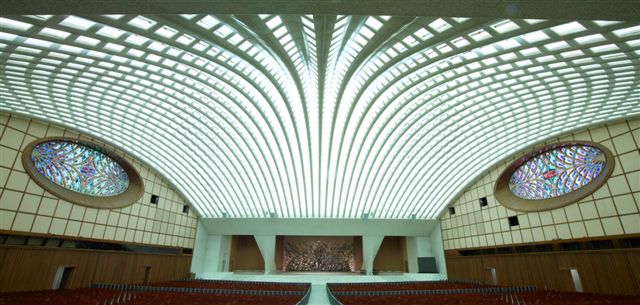
The pope’s throne is strategically positioned at the mouth of the serpent-like structure within the Paul VI Audience Hall. The Jesus-like statue in the hall has a striking resemblance to a serpent and represents temptation, deception, and ultimately reflecting the spirit of Satan.
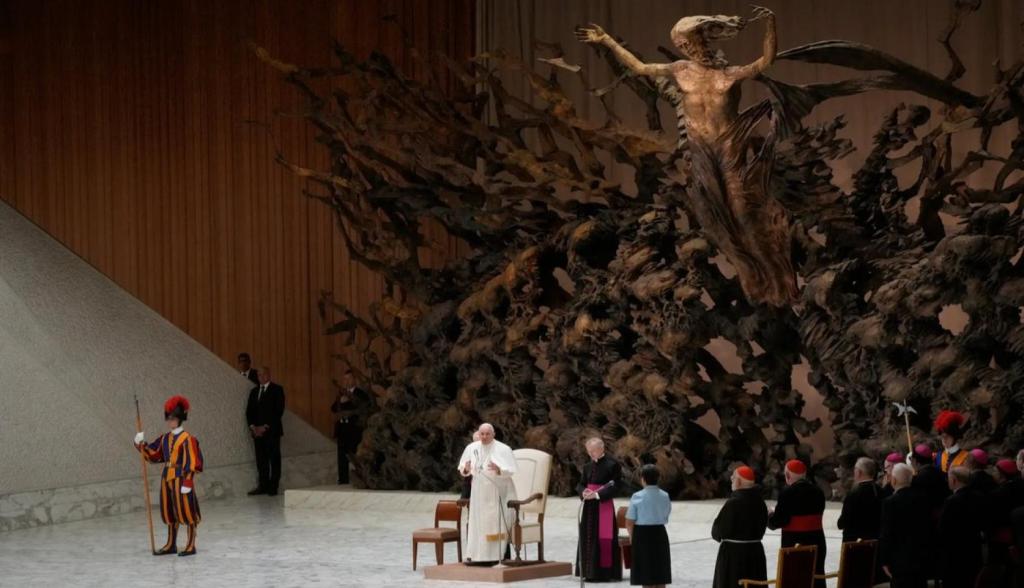
This intentional positioning suggests that the pope is the serpent’s spokesperson, communicating its message to the audience and the world at large. What’s more disturbing is that the Vatican’s telescope is named Lucifer.
Conclusion
Babylon did not disappear, but instead it became the Roman Catholic Church. This is because certain practices and methods of worship are more closely related to Babylonian worship than what the scriptures say.
The Queen of Heaven mentioned in the Bible, particularly in Jeremiah 7:18 and 44:17-19, 25, refers to Semiramis (Ishtar), the Babylonian Queen. Images of her can be found today everywhere, from the Catholic Church in the form of the Virgin Mary to Starbucks Coffee cups with her picture on them. This is how a single woman destroyed the world.
Finally, I encourage you all to take this message seriously. It is never too late to act. Get out of Babylon while you still can.
Sources
- Hislop, A. (1853). The Two Babylons. London: Partridge and Oakey.
- The Holy Bible (NIV). Jeremiah 51:6.
- The Holy Bible (NIV). Revelation 18:4.
- Barnes, T. D. (1981). Constantine and Eusebius. Harvard University Press.
- MacMullen, R. (1984). Christianizing the Roman Empire: AD 100-400. Yale University Press.
- Oppenheim, A. L. (1977). Ancient Mesopotamia: Portrait of a Dead Civilization. University of Chicago Press. (under the category “The history of Babylon and its influence on Western culture”)
- Saggs, H. W. F. (1988). The Might That Was Assyria. Sidgwick & Jackson. (also under the category “The history of Babylon and its influence on Western culture”)




 Makewetalknow
Leave a reply to Exposed: Jesus Christ Did Not Die on The Cross – Makewetalknow Cancel reply