
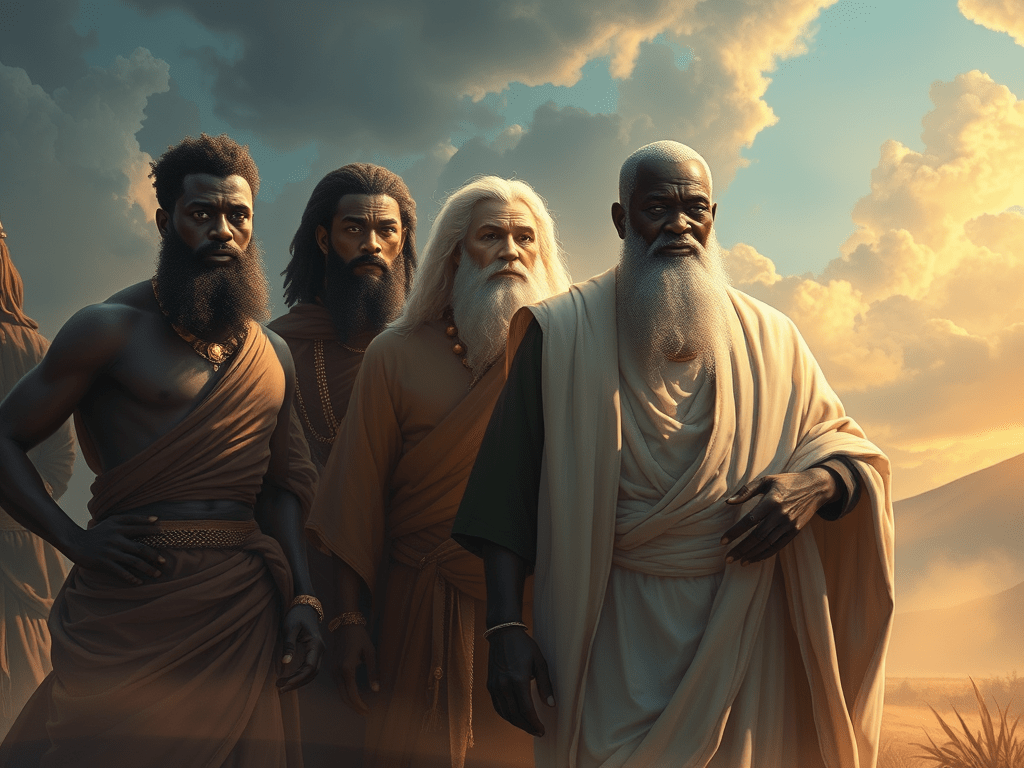
I will never stop saying it: the Bible was edited and rewritten by evil people who purposefully withheld certain information from us. This is why almost every version of the Bible includes many difficult-to-understand stories that require God’s grace.
Many Christians have misunderstood the term “Ham saw his father nakedness.” They continue to misinterpret it as whatever their hearts say. Some interpret it as Ham engaging in homosexual behaviour with Noah or viewing him sexually.
To properly interpret this term, it is necessary to examine the events that occurred before and after the flood. Scripture alone might not offer enough background or clarification on this issue, so it is necessary to consult ancient writings outside the Bible. The flood was a pivotal event in biblical history, sent by God for three main reasons:
- Destroy the Nephilim, the descendants of fallen angels and humans;
- Wipe out the violent descendants of Cain.
- Cleanse the earth of widespread corruption, allowing a new beginning through Noah’s family, the forefathers of a new humanity.
This means that God chose only specific humans and animals for reproduction in order to preserve biodiversity and ensure the continuation of life after the flood. But what they don’t want you to know is that Noah and his family weren’t the only ones on the Ark.
There were other people on that ark with Noah’s family, especially those from Cain’s lineage. One person who was not mentioned in the Bible but was present on the ark was a woman named Naamah. She was Cain’s great-granddaughter, who later became Noah’s second wife.
According to ancient texts like the Book of Jasher, God directed Noah to bring Naamah aboard the ark. Noah’s original plan did not include her. She came from the family of Cain, and Noah didn’t want anyone from that family on the ark. However, when the Creator instructed Noah to include her, he had no choice but to obey. He came to understand that the ark was about protecting humanity despite its flaws, not about perfection.
Naamah is mentioned in Genesis 4:22 as the daughter of Lamech and Zillah, and sister to Jabal, Jubal, and Tubal-Cain. Her brothers, Jabal, Jubal, and Tubal-Cain, helped Cain’s line develop culturally by introducing nomadic lifestyles, music, and metalwork. Their inventions not only increased their power, but also reinforced an environmentally violent culture.
Naamah grew up in this environment, where Cain’s offspring spread corruption. Unlike her brothers, she was known for her modesty and self-control, as well as her humility, which distinguished her. Her character earned her a place in Noah’s family before the flood, as there were few good women back then. Because of her refusal to accept corruption, she became Noah’s second wife and the last surviving member of Cain’s line.
Her presence on the ark ensured that humanity’s restart included a diverse range of cultural streams. Before marrying Naamah, Noah had three children from his first marriage: Ham, Shem, and Japheth. This account can be found in early traditions, but not in the Bible.
How Ham saw his Father’s Nakedness
Unfortunately for Naamah, her sins began after she had a secret affair with Ham, one of Noah’s sons. Given her status as Noah’s second wife and Ham’s stepmother, this was an abomination to God. The Bible describes this in a euphemistic way, saying that Ham “saw his father’s nakedness.”
In Hebrew, and later explanations found in Moses’ laws, this phrase refers to crossing the sacred boundaries of a father’s household and assuming authority over his marriage. In ancient times, seeing a man’s nakedness implied having an affair with his wife. When a man and a woman marry, they become one body. So, if you take a man’s wife to bed, you might as well have “seen his nakedness.”
Noah was unaware of Ham’s actions until Shem and Japheth informed him. This explains why the Bible says they “covered their father’s nakedness” (Genesis 9:23), which is a euphemism for respectfully disclosing the situation to Noah. Naamah and Ham’s relationship resulted in the birth of a child named Canaan. This explains why Noah did not directly curse Ham or Naamah, but instead cursed their child, Canaan, and his descendants.
Another interesting fact is that in ancient times, mothers named their children. Naamah gave her child the name Canaan, which translates as “the lowland one” or “the one brought low.” Where the connection becomes obvious is that Cain’s descendants lived in the lowlands east of Eden. Their entire civilization was based on lowland culture, the plains, valleys, and flatlands far from the holy mountain. Because of the curse of their ancestor Cain, they were known as lowlanders.
Naamah, the last daughter of Cain’s line, came from that exact lowland world. When she joined Noah’s family, her lowland identity was carried through the flood, so she named her son Canaan to reflect both her and, later, his world. The Canaanite people rebuilt a post-Flood lowland culture that reflected their name. Some of the cultures they built included:
- Jericho → lowland
- Sidon → coastal lowland
- Sodom & Gomorrah → lowland plains
- Phoenicia → lowland coast
- Philistia → lowland valleys
As Canaan’s descendants grew, they mirrored Cain’s lineage in behaviour, embracing violence and wickedness. According to Numbers 13:33, certain Canaanite tribes, including the Anakim, Rephaim, and Amorites, had giant or powerful rulers.
You can now see why giants were able to repopulate the earth even after the Flood. This is because Naamah, a Cain descendant, may have passed on Nephilim DNA to her son, Canaan. The reason God was against the Canaanites was because they exhibited the same violent, disobedient tendencies that caused the Flood.
Sources
- Genesis 6:1-4 (Nephilim)
- Numbers 13:33 (Anakim)
- Deuteronomy 2:10-11 (Rephaim)
- Genesis 4:17-22 (Cain’s lineage)
- Genesis 5:28-32 (Naamah, wife of Noah)
- Jubilees 4:22 (Naamah’s lineage, extra-biblical text)
- Josephus, Antiquities of the Jews (mentions giants in Canaan)


 Makewetalknow
Leave a comment