
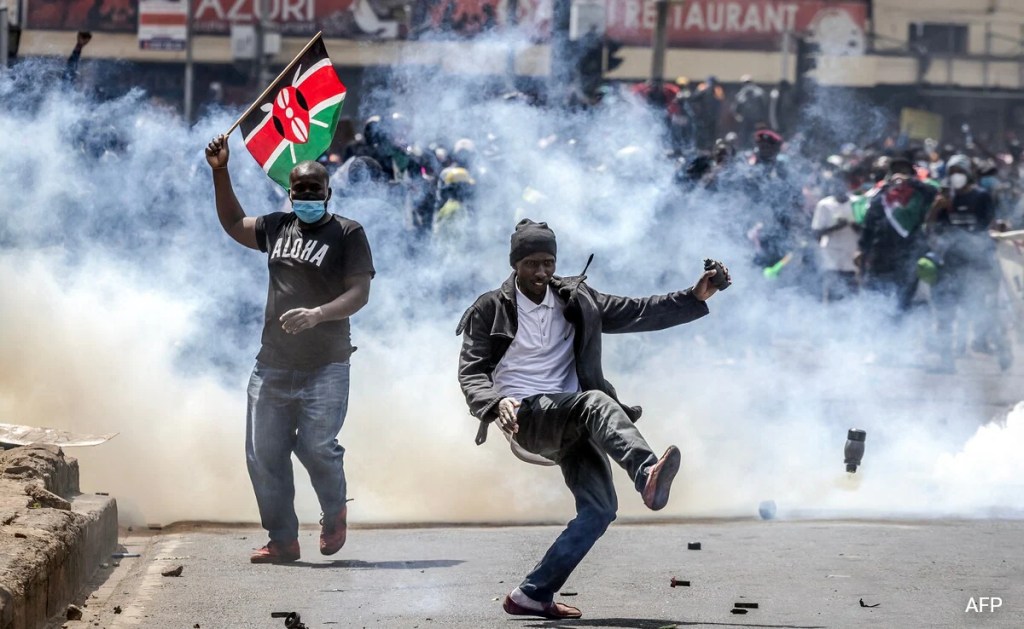
Over the past week, Kenyan youth have protested in almost every part of the country against a new finance bill, popularly known as the Finance Bill 2024, which introduces unpopular tax proposals. This particular bill has sparked widespread discontent and animosity throughout the nation. Many interpreted the finance bill as an attempt to inflict widespread hardship, with protest organizers declaring a ‘7 Days of Rage‘ and a ‘total shutdown’ of Kenya. Demonstrators, who are mostly youths with an average age of 26, are upset with the bill, which President William Ruto argues is necessary to address the heavy public debt.
The finance bill aims to generate an additional $2.7 billion in taxes as a means of alleviating Kenya’s substantial debt burden, with interest payments expected to account for 37% of the annual revenue. Many economists believe that the controversial Finance Bill will impose additional burdens on ordinary citizens and businesses, prompting an outcry from a public already struggling with the high cost of living.
Besides calling for a complete rejection of the finance bill for 2024, many youths are also calling for an end to corruption and a reduction in the cost of governance. Most of them believe that the Kenyan government can reduce waste by removing funding from all unconstitutional offices and from all non-essential items, such as the renovation of statehouses and other government buildings. They believe that by curbing all this waste, the government will be able to obtain the additional budget they desire.
The finance bill, which was first introduced in May 2024, was the subject of a fierce debate last week, with the opposition lawmakers siding with the irate protesters. The bill’s initial provisions included a plan to introduce a sales tax of 16% on bread and a duty of 25% on cooking oil. There was also a proposal to increase the tax on financial transactions and impose a new annual tax on vehicle ownership of 2.5% of the vehicle’s value.
Another proposal in the bill was the Eco Levy, which was intended to be a charge on products contributing to e-waste and environmental harm. Critics argued that the Eco Levy would increase the price of essential items, such as sanitary pads, which would be insensitive given that many girls are unable to afford these items and often miss school during their menstrual periods. Babies nappies are also reported to be affected by the eco levy.
Digital products like mobile phones, cameras, recording gear, TVs and radio gadgets are also the primary focus of this Eco Levy. It is believed that increasing the cost of these products would hurt Kenya’s digital economy, which many people in the digital industry rely on for their livelihoods. The bill also proposes increasing the import tax rate from 2.5% to 3% of the item’s value, which would be paid by the importer at the port. This increase occurs one year after the rate was reduced from 3.5% to 2.5%.
Many Kenyans have asserted on social media that since President William Ruto’s government took office in 2022, they have faced escalating taxes without commensurate improvements in public services. They accused the government of using taxation for corrupt purposes, instead of enhancing social amenities. On the other hand, Kenya’s president William Ruto defended the tax hike proposals by stating that they are necessary to repay a public debt of approximately 11 trillion Kenyan shillings that Kenya is currently obligated to repay. It is important to remember that a significant portion of Kenya’s debt is owed to China.
As anticipated, the government’s decision was criticized by many Kenyans, who called for the entire financial bill to be thrown out in a slogan that many called “reject and not amend.” Social media was flooded with a significant number of young people, including celebrities and opposition MPs, urging for widespread protest and a nationwide strike to exert pressure on the government to revoke the bill.
On Tuesday, June 18th, following public outcry, the government responded by announcing emergency changes to the bill. The emergency amendments to the bill included the removal of the proposed 16 per cent VAT on bread, transportation of sugar, financial services, foreign exchange transactions, and the 2.5 per cent motor vehicle tax.
Additionally, there will be no increase in mobile money transfer fees, and excise duty on vegetable oil will also be removed. The proposed tax on the housing fund and the one on social health insurance won’t trigger income tax, putting more cash in the pockets of workers. The proposed Eco Levy will only be applied to imported finished products that contribute to e-waste and harm the environment when they are no longer used. Locally manufactured products, including sanitary towels, nappies, phones, computers, tyres and motorcycles, will not attract the Eco Levy.
The government stated that, if the Finance Bill is successful, it will generate an income of KSh302 billion, thereby resulting in a total revenue of KSh3.3 trillion for the year. Despite these amendments, the majority of Kenyans were still not satisfied and called for a total scrap of the bill. This triggered a wave of protests and demonstrations throughout the country.
On Thursday, June 20th, demonstrators attempted to occupy the Kenyan Parliament buildings, where lawmakers were meeting for a second reading of the bill. Despite significant protests and outcries from Kenyans in general, Kenyan lawmakers proceeded to pass the bill on Tuesday, June 25th. This is no surprise, considering that most of the parliament supports President Ruto’s Kenya Kwanza Alliance. On the same day, media outlets reported that Kenyan police fired live rounds at numerous protesters who were attempting to gain entry to Parliament House in Nairobi.
The protesters broke through the barriers surrounding the Parliament and entered the building where lawmakers were discussing the proposal, prompting the police to arrive. According to Amnesty International, many protesters had been wounded, with other unverified sources estimating that at least 10 people had been killed. Within a few hours of the protest, President William Ruto addressed the public, expressing his stern stance and denouncing the unfortunate incident as an act of treason.
In his speech, President Ruto stated that legitimate protests against his policies had been hijacked by a group of organized criminals. He emphasized that his government would employ all available means to prevent a recurrence of the violence. The president’s message was an attempt to regain control following days of street protests, which have progressively increased in intensity and number. Since the country’s declaration of independence in 1963, this confrontation with a youth-led group has been considered the most challenging test of authority in Kenya.
The next few days of President Ruto’s presidency will be crucial, with showdown talks likely to continue between his government and his people. It is anticipated that President Ruto will address the concerns of the Kenyan populace and discontinue the finance bill.
Image courtesy of NDTV World


 Makewetalknow
Leave a comment