
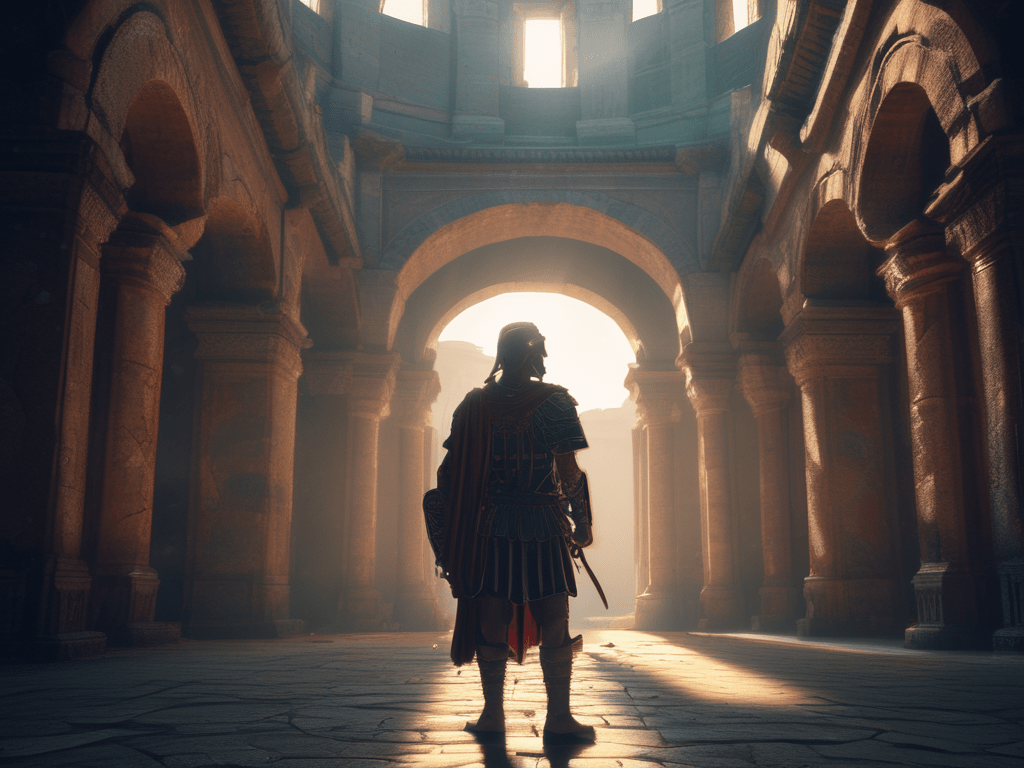
The Roman Empire’s majestic influence, which once spanned continents, eventually waned. Historians have long debated the complexities of its downfall, often attributing it to a combination of external pressures and internal conflicts. But a closer look shows that the root cause was a century-long descent into the corrupting influences of greed, ambition, and the relentless pursuit of power. As the empire’s moral foundations slowly eroded, the very fabric of its existence began to unravel, ultimately leading to its catastrophic downfall.
Through the Assassinations and Subsequent Prosperity within the Empire
The Roman Republic originated in 509 B.C.E. with the overthrow of the last Etruscan king, Lucius Tarquinius Superbus. This event marked the end of monarchical rule in Rome and paved the way for a representative democracy. Initially, the patricians dominated the Roman Republic, excluding plebeians from holding public office. However, the plebeians fought for and secured greater representation and influence within the government through the Roman Senate.
A significant shift occurred in 494 B.C.E. when the plebeians organized a strike, leading to the establishment of the Concilium Plebis (Council of the Plebs). This marked the beginning of a more representative government, with the plebeians gaining greater representation and influence. The Conflict of the Orders, a centuries-long struggle for equal political rights, led to the formation of new legislative bodies called assemblies. These assemblies included:
- Comitia Centuriata: Held significant power, making decisions about war, laws, and foreign relations.
- Concilium Plebis: Elected officials and created regulations for the plebeian class, later gaining authority to make regulations binding on the entire Roman community.
- Comitia Tributa: Tribal assemblies open to all citizens, allowing them to elect minor officials and wield judicial powers.
The Roman Republic’s governance system was designed to prevent power concentration, with two consuls sharing Senate and army responsibilities. However, as the Republic expanded, internal conflicts arose, setting the stage for the eventual fall of the Roman Republic. Internal strife, the ascent of strong individuals, and the consolidation of power all threatened the stability of the Roman Republic.
In the 1st century B.C.E., power-hungry individuals like Julius Caesar and Lucius Catiline emerged, challenging the status quo. Caesar’s rise to power transformed the Republic, bolstered by military victories in Gaul, which earned him wealth, prestige, and soldier loyalty. Caesar’s appointment as perpetual dictator marked the beginning of the end for the Roman Republic. His conflict with Pompey sparked a power struggle, ultimately leading to Caesar’s assassination. His nephew, Octavian, subsequently established the Principate, marking the Roman Empire’s beginning.
As the Roman Empire expanded, governing its vast territories from a central authority became increasingly impractical. To address this challenge, the empire was divided into provinces, each governed by a local governor responsible to Rome. This system allowed provinces to enjoy autonomy in internal affairs, provided they remained loyal and fulfilled tax obligations.
The Roman Empire’s governance system struck a balance between centralized authority and provincial autonomy, proving remarkably effective. This led to the “Pax Romana” (Roman Peace), a two-century period of unprecedented stability, peace, and prosperity. At its height, the empire stretched from England to Morocco and from Spain to Iraq, united by an extensive network of roads, trade routes, and administrative systems. These connections facilitated the exchange of goods, ideas, and cultures, fostering a rich and diverse cultural heritage that would leave a lasting legacy.
The Beginning of the Roman’s Empire’s Decline
The Roman Empire’s governance system was complex, with a delicate balance of power between the emperor, the Senate, and provincial leaders. At its core, the empire relied on a system of checks and balances, with the Senate and assemblies providing oversight and representation for citizens. The empire’s leadership structure evolved from a monarchical system to a republican government, and eventually, to an imperial system under Augustus. This shift brought significant changes, including the reorganization of provinces and the establishment of a more centralized leadership. However, the empire’s monarchical system often prioritized birthright over leadership qualities, leading to ill-equipped leaders like Commodus. His rule was marked by chaos, violence, and corruption, ultimately leading to his assassination in 192 CE.
In contrast, the Roman Republic’s governance system was designed to prevent power concentration, with two consuls sharing Senate and army responsibilities. Key components of this system include:
- Provincial Governors: Managed internal affairs in their respective provinces, reporting to Rome and maintaining loyalty.
- The Senate: A powerful advisory body composed of aristocratic citizens who held significant influence over Roman politics.
- The Assemblies: Represented the voice of Roman citizens, enacting legislation and electing officials.
- The Consuls: The highest executives in the Roman Republic, elected annually and serving limited terms.
Rome’s chaotic political climate made its weaknesses visible to outsiders. As the government degenerated, provinces with distinct cultures began to contemplate secession, leading to a rapid breakdown and the eventual fall of the Roman Empire. The Roman Empire’s collapse was a complex, multi-faceted process. It began with the secession of the Gallic Empire, which took modern-day France and England, and the Palmyrene Empire, led by Queen Zenobia, not Queen Zeneca, which gained control of Egypt, the eastern Mediterranean coast, and key sites in the Holy Land.
Emperor Aurelian’s five-year rule marked a pivotal turning point, as he conquered hostile tribes, reclaimed the Palmyrene and Gallic empires, and implemented key reforms. His efforts laid the groundwork for successors Diocletius and Constantine the Great to strengthen the empire.
Constantine’s 31-year reign was marked by significant achievements, including introducing a new currency, expanding the empire’s territory, and restructuring the Roman army. He also transformed the Roman Empire into a Christian state, which had far-reaching consequences. However, the empire faced numerous challenges, including internal conflicts, corruption, and external threats. The emergence of the Hun Empire, a nomadic people from Central Asia, the Caucasus, and Eastern Europe, posed a significant threat. The Huns’ invasion led to a massive influx of displaced barbarians, which Rome struggled to manage.
The empire’s instability continued, with Emperor Theodosius attempting to restore order through military revitalization. However, his efforts were hindered by financial strain, and his death in 395 CE led to a power vacuum. The division of the empire into eastern and western halves marked a significant turning point, as the Western Roman Empire began its decline.
The Roman Empire’s collapse was further exacerbated by a combination of factors, including climatic crisis, migrational crisis, financial crisis, social crisis, and political crisis. Climate change and disease outbreaks, such as the Antonine Plague, weakened the empire. Mass migrations of barbarian groups, driven by the Huns, put pressure on the empire’s borders.
Excessive military expenditure, corruption, and economic strain contributed to the empire’s decline. The empire’s social structure, including the rise of a powerful Catholic Church, created internal tensions. Weak leadership, civil wars, and external threats eroded the empire’s stability. The Empire’s collapse was a gradual process that occurred over several centuries. The empire’s instability continued, with various groups vying for power. The Western Roman Empire eventually fell to barbarian tribes, marking the end of the Roman Empire’s dominance.
The Fall of the Roman Empire
As Rome’s decline accelerated, the Hun Empire, led by the feared Attila, gained momentum. Attila sought to capture Rome and end its global dominance through a series of relentless attacks. Over the next 80 years, the Roman Empire faced numerous challenges, including brutal Hun attacks on its borders and Gothic uprisings within. Massive reorganizations weakened the Roman army, rendering it a shadow of its former self. The empire’s military struggles led to retreats and losses, further eroding its power. As the Roman Empire continued to fragment, its territories broke away, and its influence waned.
Rome transformed from a powerful empire to a diminishing city-state, its dominance slowly fading. Despite efforts by various emperors to strengthen the Roman army, none succeeded in reclaiming lost territory. The Roman Empire encountered numerous obstacles until 476, when Odoacer, an ambitious king, terminated its existence. Odoacer, the first barbarian king of Italy, would become a significant figure in history.
Romulus Augustus, the last Roman Emperor, was only 16 when Odoacer invaded Rome. Despite his bravery, Romulus was defeated, but Odoacer spared his life, exiling him to Campania instead. Odoacer established himself as the supreme ruler of Italy, marking the fall of the Western Roman Empire in 476 CE. However, many historians consider Odoacer a foreign occupier, and the Roman Senate didn’t recognize him as a legitimate ruler.
Instead, they awarded the seal of Rome to the Byzantine Empire, solidifying the Eastern Roman Empire’s presence in European history. Interestingly, Odoacer’s rise to power was facilitated by his cooperation with the Roman Senate, which granted him legitimacy and support. Odoacer tried to establish a stable rule, but Theodoric the Great killed him in 493 CE.
Conclusion
The Roman Empire’s demise was largely attributed to its lack of strong leadership and ineffective governance. The position of emperor was not merit-based, but rather handed down through inheritance, creating a power vacuum where leaders prioritized maintaining power over governing effectively.
In the 75 years leading up to Rome’s fall, 27 men held the throne, often securing their positions through violent means. Assassination was a common tactic, and this brutal culture defined Rome’s leadership style. Even long-reigning emperors prioritized personal interests over the empire’s well-being, appointing loyal allies to key positions and treating the empire as their personal domain. The Praetorian Guard’s influence over the government grew, and the Roman army’s military effectiveness declined.
The Roman military’s weakness was exposed when the Goths arrived at the empire’s borders. A well-prepared military might have defeated the Gothic armies, but instead, the Romans opted for a conciliatory approach. The empire’s treatment of Gothic refugees was a crucial factor contributing to its downfall. By denying them shelter and exploiting their labour, the Romans missed an opportunity to foster loyalty and recruit future warriors.
The Roman Empire’s lack of democracy was a significant contributor to its downfall. The concentration of power in the hands of a few individuals led to an unstable environment where rulers were frequently overthrown, and power struggles were commonplace. The Roman Republic’s shift towards autocracy, particularly with the rise of Julius Caesar, marked a significant turning point in the empire’s decline. The empire’s foundations were further weakened by the widespread discontent among the population, which was a result of the lack of representation and accountability.


 Makewetalknow
Leave a comment