

The timeless tale of Aladdin has its roots in Middle Eastern folklore, featured prominently in the renowned literary collection, One Thousand and One Nights (Arabic Nights).
Although not part of the original Arabic manuscript, the story was introduced to the collection by French orientalist and archaeologist Antoine Galland in the 18th century. Galland sourced the narrative from Hanna Diyab, a Syrian Maronite storyteller.
Historians credit Diyab as the primary author of Aladdin and the Magic Lamp, suggesting that his personal experiences likely influenced the tale’s development.
Since its emergence in the 18th century, the story of Aladdin and the magic lamp has captivated audiences worldwide, earning its place as one of the most enchanting and mysterious tales of all time.
To verify this claim, English poet and translator John Payne referenced passages from Antoine Galland’s unpublished diary. The diary entries documented Galland’s encounter with Hanna Diyab, a Maronite storyteller from Aleppo, and their subsequent journey from Aleppo to Paris with French traveller Paul Lucas on March 25, 1709.
According to Galland’s diary, he had a meeting with Hanna and had embarked on a journey from Aleppo to Paris with the renowned French traveller, Paul Lucas, on the 25th of March in the year 1709.
Galland’s diary further reveals that his transcription of Aladdin for publication occurred during the winter of 1709 and 1710. It was incorporated in the volumes 9 and 10 of One Thousand and One Night, which were released in the same year.
Must Read: Revealed: We Existed in Heaven as Celestial Beings Before We were Born into this World
John Payne also describes his discovery at the Bibliothèque nationale de France of two Arabic manuscripts containing Aladdin, as well as two additional details. The first manuscript was said to be written by Dionysus, a Syrian Christian priest who lived in Paris. The second manuscript is thought to be a copy of a manuscript written by Mikhail Ibrahim Sabbaths in Baghdad in 1703.
The Origin and Truth behind Aladdin and his Genie
The concept of Genies originated from ancient Middle Eastern mythology, where they were known as Jinn (also spelled Djinn). The term Jinn refers to supernatural beings that can be either benevolent or malevolent, depending on the context. According to Britannica, a Jinn is:
Jinni, plural jinn, also called genie, Arabic jinnī, in Arabic mythology, a spirit inhabiting the earth but unseen by humans, capable of assuming various forms and exercising extraordinary powers.
Britannica
Islam’s expansion facilitated the incorporation of knowledge from other religions, enabling a more precise understanding of supernatural entities like genies (Jinn) within Islamic teachings.
Although the concept of Jinn is not exclusive to Islam, it likely absorbed elements from pre-Islamic pagan beliefs. In Islamic tradition, Jinn coexist with demons (Shayatin) as distinct spiritual entities.
Interestingly, some noble Jinn are also referred to as demons, blurring the lines between the two. Scholars, both Islamic and non-Islamic, generally categorize angels, Jinn, and demons as three separate types of spiritual beings.
Jinn were also distinguished from demons (Shayatin) by their dual nature, possessing both virtuous and malevolent qualities. In contrast, demons were solely defined by their inherent evilness, lacking any redeeming attributes.
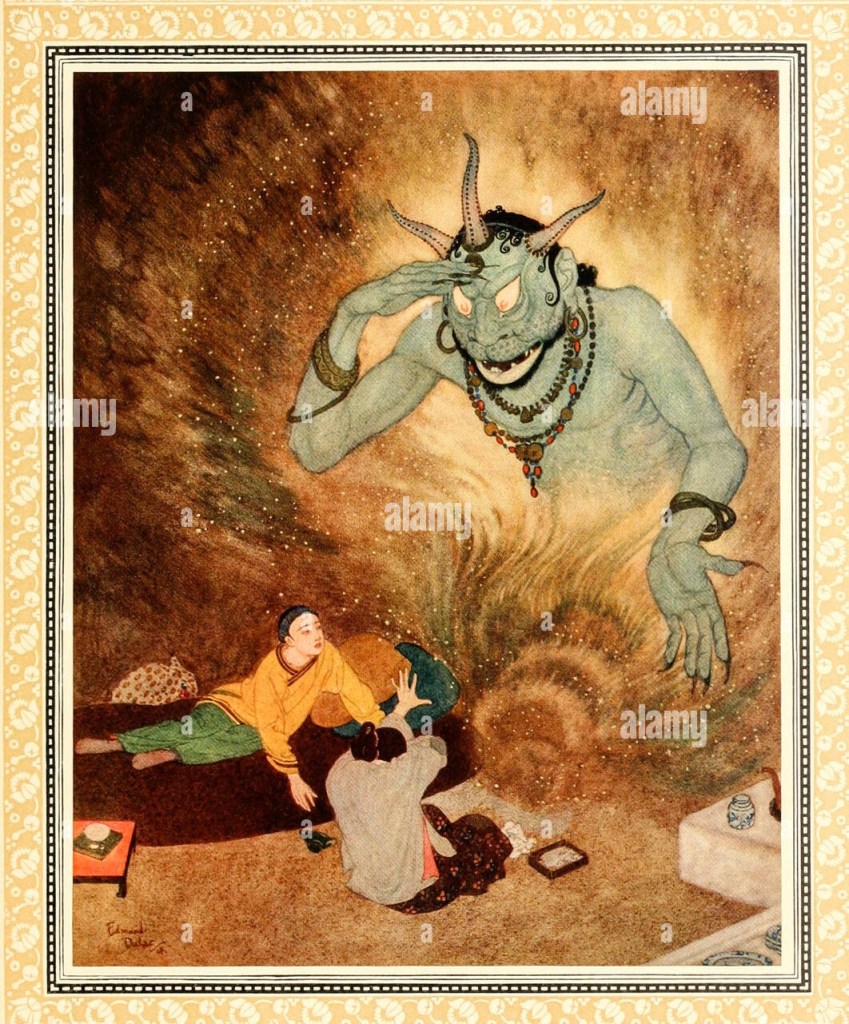
Contrary to the legend that genies (Jinn) can be distinct from demons and possess a dual nature of good and evil, the pseud epigraphic text known as the Testament of Solomon suggests that genies are, in fact, a type of demon. This ancient manuscript presents a more sinister view of genies, implying that they are malevolent entities rather than morally ambiguous beings.
Testament of Solomon
The Testament of Solomon is a pseud epigraphical text attributed to King Solomon, linking it to the Old Testament. However, it has never been considered a sacred text by Jewish or most Christian communities. Composed in Greek, the text draws on early first-millennium CE sources, but its written form likely emerged during the medieval period.
According to the Testament of Solomon, King Solomon built his temple with demons, controlled using a magical ring given to him by Archangel Michael. The text describes Solomon’s encounter with Ephippas, a demon from Arabia, whom he imprisoned in a container resembling Aladdin’s lamp. Chapters 117-124 recount how Solomon captured Ephippas, forcing him to lift a massive stone for the Temple’s construction in Jerusalem.
Read now: Exposed: UFO’s are Chariots from Heaven sent by God to Watch Humanity
With help from another spirit, Ephippas suspended a pillar in the air, showcasing Solomon’s wisdom. The Testament of Solomon also revealed that genies are, in fact, demons. While the Disney movie Aladdin may be entertaining, it has a troubling historical connection to King Solomon’s ability to command demons.
Furthermore, according to the Testament of Solomon, God granted King Solomon the extraordinary ability to summon demons from various realms, enabling him to construct the First Temple between 990 and 931 BCE.
To harness the demons’ power and prevent them from causing harm, Solomon employed a container or flask to entrap and subdue them. Interestingly, this ancient vessel bears a striking resemblance to the magical lamp used by Aladdin to release the Genie, highlighting a fascinating historical parallel between the two narratives.
Read more: How Satan is using Hollywood to promote the LGBT Agenda and more
So, what does this indicate? The similarities between the container used by King Solomon to subdue demons and Aladdin’s magical lamp suggest a fascinating connection. This indicates that the true origins of the Aladdin story may have been influenced by the ancient narrative of King Solomon, as documented in the Testament of Solomon.
Disney practically borrowed from Solomon’s encounter with demons, but with a creative twist. They portrayed them as kind-hearted in the animated film Aladdin, whereas the original depiction of demons or entities like Genie are often associated with trouble and suffering.
Conclusion
Once again, Disney attempted to promote satanism on television by promoting the portrayal of evil characters as being good. This is not the first time they have done it. Cartoons such as The Little Mermaid, Hercules, Fantasia, Peter Pan, Mary Poppins, Beauty and the Beast, and Frozen promote the use of magic enchantment or the worship of dark creatures.
Despite being aware of Genie’s sinister origins, Disney still managed to convince children that summoning demons in exchange for prosperity is acceptable. In reality, this ploy was intended to make it acceptable to welcome demons.
According to biblical teachings, demons are believed to be disembodied spirits, bound to the earthly realm without physical form. This existence is thought to fuel their desire to negotiate with humans, offering temptations of wealth, fame, or power in exchange for freedom or release.
The biblical account of King Solomon’s interactions with demons, as recorded in the Testament of Solomon, indicates that he received divine guidance to capture and bind these entities. This action was allegedly necessary to prevent the demons from wreaking havoc and chaos on the world, thereby protecting humanity from their malevolent influence.
In conclusion, it’s essential to be mindful of the cartoons your kids watch, especially those that promote magic, witchcraft, or portray dark creatures as benevolent beings, as they may shape their perceptions of what’s acceptable and influence their worldview.
Featured Image courtesy of Wales Millennium Centre



 Makewetalknow
Leave a comment